About Lurocalis semitorquatus (J.F.Gmelin, 1789)
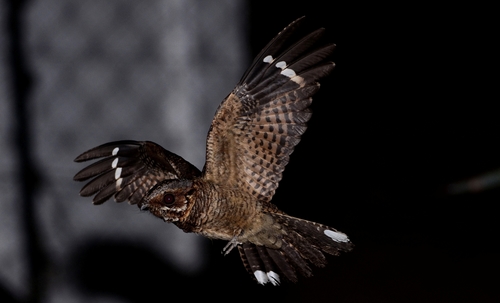
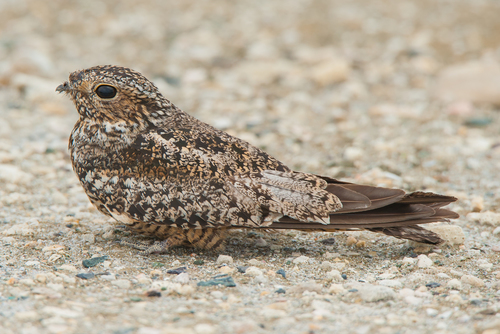
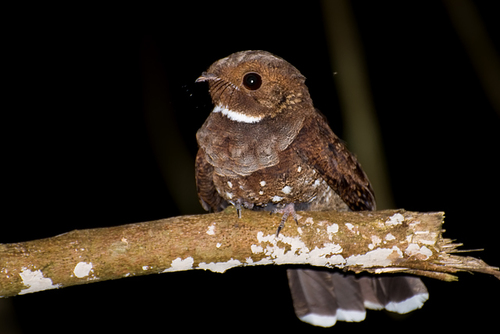
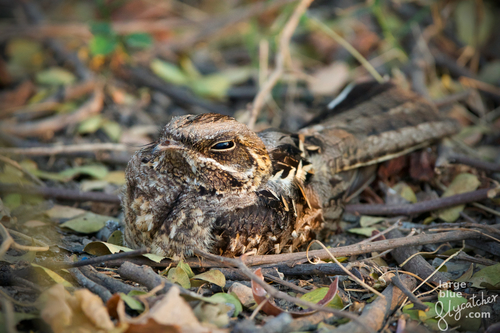
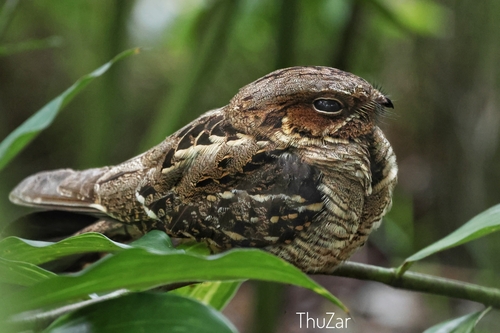
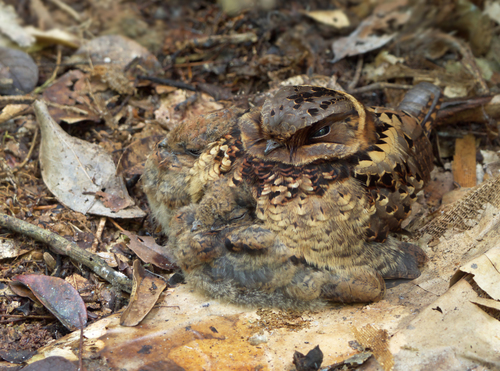
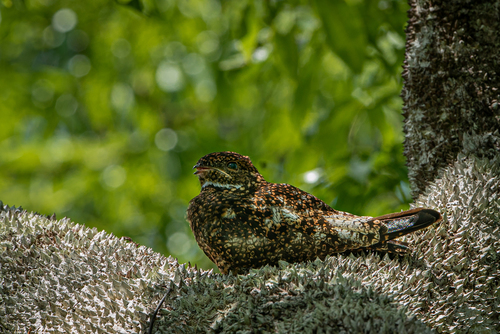
The short-tailed nighthawk (Lurocalis semitorquatus) measures 19 to 21 cm (7.5 to 8.3 in) in length. Recorded weights include 79 g (2.8 oz) for one female of the nominate subspecies L. s. semitorquatus, and 82 to 89 g (2.9 to 3.1 oz) for several males of subspecies L. s. nattereri. It is a rather large nightjar with an unusually short tail. Its upperparts are dark brown to blackish, marked with rufous and buff spots and speckles. The wings are also dark brown with muted multi-colored spots, and unlike most other nighthawks, they lack bold white markings. The tail is brown with tawny or grayish bars, and ends in a narrow buffy or whitish band. The chin is dark brown, the throat is white, the upper breast is dark brown with lighter speckles, the lower breast is buff with brown bars, and the belly and flanks are tawny buff with brown bars. Subspecies of the short-tailed nighthawk differ slightly in size, as well as in the extent and intensity of the spots, speckles, and bars that overlay their base plumage color. The species' most common vocalization varies slightly between subspecies: for L. s. nattereri it is described as a "constantly repeated but well-spaced ewIT ... ewIT ... ewIT ...", while for L. s. stonei it is described as "a sharp, slightly liquid g'wik or gweek". This vocalization is produced both when the bird is perched and when it is in flight. The short-tailed nighthawk is widely distributed across Central and northern South America. It primarily inhabits lowland evergreen forest, but is also found in more open landscapes including forest clearings, river edges, old cacao plantations, and middle-aged secondary forest. Northern populations of the species are generally resident, though the seasonal distribution of Amazonian subspecies is not well understood. Southern populations are migratory, and may travel as far north as Venezuela during the austral winter.