About Lupinus texensis Hook.
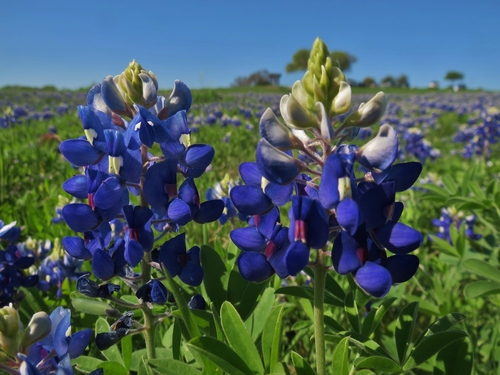
Lupinus texensis, commonly known as the Texas bluebonnet or Texas lupine, is a species of lupine native to Texas, Louisiana, and Arkansas in the United States, as well as the Mexican states of Coahuila, Nuevo León, and Tamaulipas. Along with other related lupine species also called bluebonnets, L. texensis is the state flower of Texas. This plant is an annual species that starts its life as a small, gravel-like seed. The seed has a hard outer coat that must be worn away by wind, rain, and weathering over the course of several months, and sometimes even several years, before germination can occur. In fall, bluebonnets emerge as small seedlings with two cotyledons. They later develop a rosette of palmately compound leaves, each bearing five to seven leaflets that are 3–10 cm long, green with a faint white edge and covered in fine hair. Growth continues through the mild winter, before speeding up rapidly in spring. The plant grows larger before producing a 20 to 50 cm tall flower plume bearing blue flowers, which often include bits of white and occasionally a faint pinkish-red tinge. The scent of these blooms has been described in varying ways: many people report the flowers have no detectable scent, while a small number describe the scent as sickly sweet. The hard outer shell of bluebonnet seeds protects the seeds during dry conditions, as the plant grows better in years with higher moisture. Before storage, seeds may undergo scarification, a process that weakens the hard seed casing to encourage germination. When scarified and stored at 22 degrees Celsius, seeds show no reduction in germinability one year after harvest and treatment. Isolated color mutations have been found in wild populations of L. texensis, most notably producing all-white flowers, pink flowers, and the deep maroon 'Alamo Fire' variation. These mutations have since been selectively bred to create different colored commercial strains. Texas officially recognizes all native lupine species that occur in the state as the official state flower. This means that other species such as L. subcarnosus and L. havardii are also commonly called bluebonnets, though there are clear distinguishing features that separate these species from L. texensis.