About Lupinus polyphyllus Lindl.
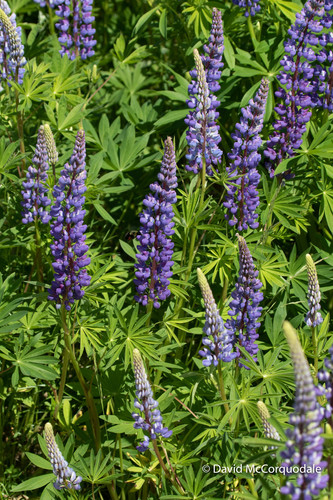
Lupinus polyphyllus Lindl. is a perennial herbaceous plant with stout stems that grow 1.5 metres (4.9 ft) tall. Its leaves are palmately compound, with 9–17 leaflets that measure 3–15 centimetres (1.2–5.9 in) long. Flowers grow on a tall spike, with each flower 1–1.5 centimetres (0.39–0.59 in) long; wild plants most commonly have blue to purple flowers, and bumblebees are the main visitors to these flowers. Lupinus polyphyllus varieties specifically contribute to a large number of hybrids commonly grown as garden lupines, which can have a very wide range of flower colours. Most lupines do not grow well in rich heavy soils, and often only survive for a few years when grown in these conditions. This is because contact between the plant crown and manure or rich organic matter encourages rotting. From an ecological perspective, this lupine can pose a major threat to the survival of the endangered Karner blue butterfly. It easily hybridizes with the Karner blue butterfly's food plant, Lupinus perennis, also called wild perennial lupine. Some sources note that commercial lupine seeds are already problematic for the Karner blue butterfly due to this hybridization, and humans continue to introduce incompatible lupines into areas where the Karner blue butterfly currently or historically lived. In cultivation and use, Lupinus polyphyllus is commonly grown in gardens. It is popular because it attracts bees, produces attractive flowers, and its nitrogen-fixing ability can improve poor sandy soils. Numerous cultivars have been selected to produce a range of different flower colours, including red, pink, white, blue, and multicoloured blooms with different colours on separate petals. Hybrids between L. polyphyllus and L. arboreus are commonly used, and sold under hybrid cultivar names such as Rainbow Lupins, Lupin Tutti Fruitti, the mixed Band of Nobles, yellow Chandelier, red My Castle, white Noble Maiden, pink The Chatelaine, and blue The Governor. This is a very hardy plant that can survive extreme temperatures and withstand frost down to at least −25 °C (−13 °F). Wild varieties can easily become invasive and are difficult to remove unless regularly controlled. Growing lupins in pots can help prevent them from spreading invasively into the ground. These plants need a moderate amount of sun to survive, grow best in light soils, and do poorly in heavy clay soils. Once fully established, they are extremely resilient and can be divided. Seeds harvested from a parent plant will never grow into an exact genetic copy of the original, even if the resulting plants have similar flower colouring. Low-alkaloid (also called sweet) cultivars of this lupine suitable for use as fodder crops have been bred. To prevent the restoration of alkaloid synthesis in cross-pollinated lupine species, a new specific crossing-based approach has been developed. Only compatible plant forms are used for hybridization, and their low alkaloid content is controlled by the same genetic system. This approach has allowed this bitter weed to be transformed into a valuable fodder crop. In Northwest growing conditions in Russia, positive results have been achieved using the sweet commercial cultivar "Pervenec", the first developed sweet variety, which is included in the State Catalogue of selection achievements of Russia. Breeding of sweet lupine is also conducted in Finland. Modern newer garden hybrids are highly poisonous because they contain high levels of toxic alkaloids, and should never be eaten. This species is also toxic to livestock.