About Lupinus perennis L.
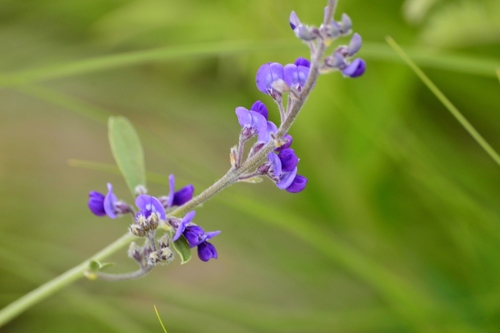
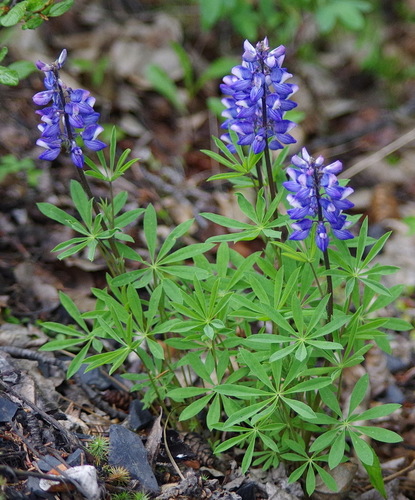
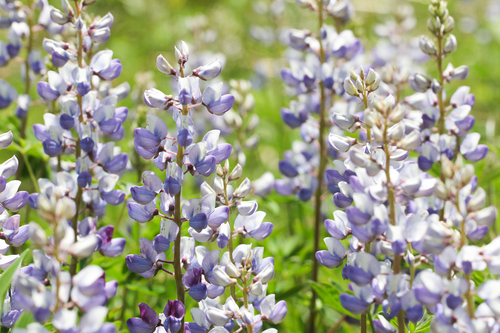
Lupinus perennis L. has palmately compound leaves made up of 7 to 11 leaflets arranged radially. Its stems are numerous, erect, striated, and slightly pubescent. Leaflets are obovate, with either a blunted apex or a pointed spear shape, and are sparsely pubescent. Petioles are longer than the leaflets, and the stipules are very small. The inflorescence is a terminal raceme that can be loosely spaced or weakly whorled, and it is long and sparsely flowered, sometimes almost verticillate. Flower colors range from white and pink to blue and violet, with blue shades being the most common. The calyx is silky, lacks bractlets; its upper lip may be slightly notched (integral or weakly emarginate with a protuberant base), while the lower lip is entire and nearly twice the length of the upper lip. The corolla is approximately three times longer than the calyx. Floral bracts are styliform, shorter than the calyx, and are present early but fall off as flowers mature. The vexillum is shorter than the wings, and the carina is weakly ciliate. After pollination, the plant produces a legume pod that is yellow-gray to yellow-grayish-brown, lightly to densely hairy, constricted between seeds to give it a necklace-like or bead-like appearance. Pods are short, easily shattered, and typically contain 5 to 6 seeds; each seed is oval-shaped with a pale or light-colored hilum. Germination in this species occurs at roughly equal rates during the day and night. Seeds of L. perennis require scarification to germinate, and the ideal temperature range for germination is 24–29 °C (75–84 °F). Lupinus perennis is often confused with Lupinus polyphyllus (large-leaved lupine), a Western species that is commonly planted along roadsides. L. polyphyllus is not native to eastern North America, but has become naturalized in parts of the upper Midwest and New England. L. polyphyllus has 11–17 leaflets that can reach 13 cm (5 in) in length, while L. perennis has 7–11 leaflets that only reach around 5 cm (2 in) in length. This species is widespread in the eastern United States, ranging from Texas and Florida north to Maine, plus Minnesota; it also occurs in Canada in southern Ontario and Newfoundland and Labrador, and along Atlantic Ocean coasts. It grows in sandy areas including dunes and savannas, and is most commonly associated with well-drained sandy soils and open, high-light habitats such as oak savannas, pine barrens, dunes, and sand plains. Many of these habitats are disturbance-dependent, and suppression of natural fire regimes has contributed to widespread population declines across the species’ range. Lupinus perennis reproduces exclusively by seed. Pods mature in mid-summer and dehisce explosively when dry, dispersing seeds short distances away from the parent plant. Seeds have a thick, impermeable seed coat that creates physical dormancy and allows long-term persistence in the soil seed bank. Germination studies show that dormancy is primarily broken by scarification rather than light exposure, with optimal germination occurring at temperatures between approximately 24 and 29 °C. Biochemical studies indicate that enzymatic activity and stress-related plant hormones help weaken the seed coat and initiate germination. Long-term storage experiments have confirmed seeds remain viable after more than seventeen years, demonstrating the species’ ability to persist under unfavorable conditions. Lupinus perennis serves as a food plant for caterpillars of several Lepidoptera species. These include the clouded sulphur, eastern tailed blue, gray hairstreak, silvery blue, wild indigo duskywing, frosted elfin (Callophrys irus), the eastern Persius duskywing (Erynnis persius persius), and the rare and endangered Karner blue (Plebejus samuelis, also known as Lycaeides melissa samuelis), whose caterpillars feed only on the leaves of this lupine. Leaves fed on by Karner blue caterpillars have distinctive transparent areas, where the larvae have selectively eaten only the green, fleshy portions of the leaf. Lupinus perennis plays an important ecological role as both a pollinator resource and a nitrogen-fixing species. Like other legumes, it forms symbiotic relationships with nitrogen-fixing bacteria in root nodules, which improves soil fertility in nutrient-poor environments. The species supports a wide range of insect visitors, particularly bees, and acts as a critical larval host plant for several Lepidoptera. Most importantly, it is the only larval host for the endangered Karner blue butterfly, as well as an important host for species such as the frosted elfin and Persius duskywing.