About Lupinus luteus L.
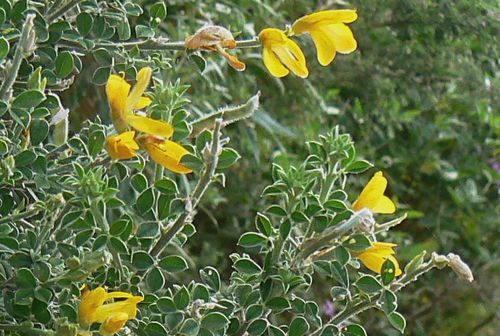
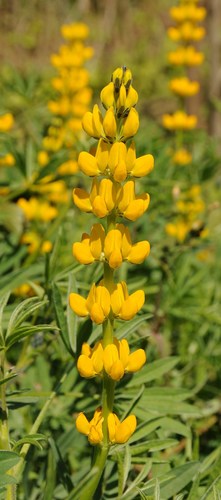
Lupinus luteus L. is commonly known as annual yellow-lupin, European yellow lupin, or simply yellow lupin. It is native to the western Mediterranean region, ranging from Portugal east to Italy. This is an annual plant that grows to approximately 80 cm tall, and it has hairy stems. Its leaves are palmately compound, bearing 7 to 11 leaflets; each leaflet measures around 6 cm long and 12 mm broad. Its flowers are bright yellow, 13 to 16 mm long. These flowers grow on interrupted spikes, arranged in regularly spaced verticillasters along the stem. Yellow lupin grows on mild sandy and volcanic soils. As a wild plant, it is widespread across the coastal areas of the western Iberian Peninsula, the islands of Corsica, Sardinia, and Sicily, and in Southern Italy. It has become naturalised in northwest Africa (Morocco, Tunisia, and Algeria), across much of Europe, in southwest Asia (Syria, Israel, and Lebanon), and more distantly in Ethiopia, India, and other locations. It is cultivated in Northern Europe, including Belarus and Ukraine, and on a smaller scale in Western Australia and South Africa. When classified using traits like corolla color, carina edge shape, and characteristics of vegetative organs and seeds, 18 varieties, 4 subvarieties, and 6 forms of this species have been identified. The plant's yellow seeds, known as lupin beans, were once a common food throughout the Mediterranean basin. Today, these seeds are primarily eaten as a pickled snack food. The species is also cultivated to feed livestock and poultry, and grown as an ornamental plant.