About Lupinus kuschei Eastw.
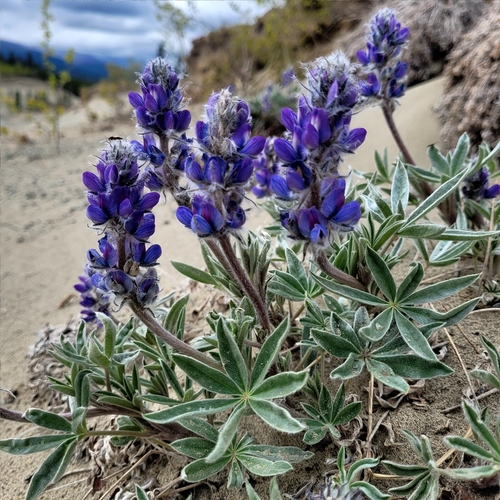
This species, Lupinus kuschei Eastw., has stems that grow 15 to 50 centimeters tall. Its leaves bear 5 to 9 leaflets, and their petioles measure 4 to 15 centimeters long. The leaflets are elliptic in shape, and range from 1.5 to 5 centimeters in length. The plant's flowers are arranged in racemes 3 to 10 centimeters long, and have a two-lipped calyx: the upper lip of the calyx is 4 to 6 millimeters long, while the lower lip measures 5 to 7 millimeters long. The corollas of L. kuschei are 10 to 13 millimeters long, and can be blue, purple, white, or violet. Flowering occurs in June and July, and the fruit is a legume. The fruit pods are 2 to 3 centimeters long, and contain seeds 4 to 6 millimeters long.
Lupinus kuschei can be distinguished from other related lupine species by several key traits. It differs from Lupinus nootkatensis by its long-petioled basal leaves and acute leaflets. It differs from Lupinus arcticus by having silky leaflets on both sides. It differs from Lupinus lepidus by having glabrous keels, and stems, pedicels, and calyx covered in spreading, villous pubescence. It differs from Lupinus sericeus by its flower banners that are not hairy on the back.
In terms of habitat, Lupinus kuschei grows in conifer forest and sand dune habitats, and prefers sandy or gravelly soil. It can also be found on sand bars of glacial rivers, river terraces, and sandy alluvium. It often occurs in mesic to dry, sandy, gravelly, or rocky openings, alpine fields, and along roadsides. Documented associated species include Dryas drummondii, Hedysarum mackenzii, Epilobium latifolium, Oxytropis campestris, Oxytropis deflexa, Pinus contorta, Arctostaphylos species, Shepherdia canadensis, Calamagrostis purpurascens, Festuca rubra, Solidago decumbens, Populus balsamifera, and Salix species.
For distribution, most populations of Lupinus kuschei are located in southwestern Yukon, with additional populations in northern British Columbia and east-central Alaska. Disjunct populations also exist in northwestern Alaska. The total range extent can reach up to 250,000 square kilometers, as populations in northwestern Alaska have not yet been fully mapped. Unconfirmed, questionable reports suggest a possible population in southern British Columbia. The species is most often observed in June and July; 75.1% of recorded observations are from Canada, and 13.2% are from the United States.