About Lupinus havardii S.Watson
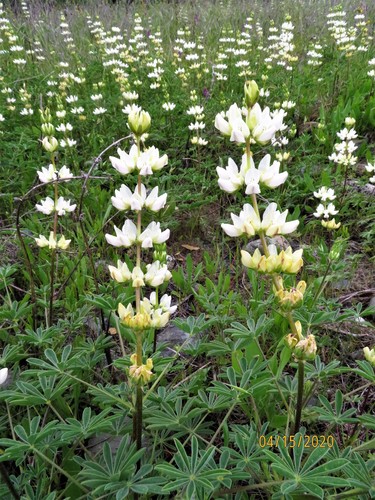
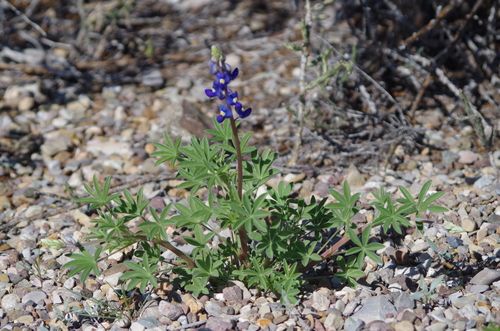
Lupinus havardii S.Watson is a species of lupine with the common names Big Bend bluebonnet and Chisos bluebonnet. It is native to Texas and Chihuahua, where it blooms between January and June. Its natural habitats include deserts, valleys, hills, and mountain slopes, growing in gravelly, fine talus, and alluvial soils. It is an erect annual herb with a slender, branching stem that can reach over 4 feet in height. Both the plant height and flower stalk height depend on available soil moisture: plants can be as short as a few inches, and the tallest recorded specimen reaches 5 feet 4 inches. Flowers are roughly half an inch long, and range in color from purple to blue. The spot on the flower's banner is white to yellow when the flower is fertile, and turns red once the flower is no longer fertile. This color change makes the less fertile flower less visible to bees, encouraging them to visit fertile flowers instead. Each palmate leaf is made up of around seven leaflets. White and pink blooming plants are very rarely seen in the wild. These rare color variants have been isolated and propagated by horticulturalists at Texas A&M University, and they, along with the original blue flowered plants, are sold as a premium cut flower. The specific epithet of Big Bend bluebonnet honors surgeon and botanist Valery Havard.