About Lupinus brevicaulis S.Watson
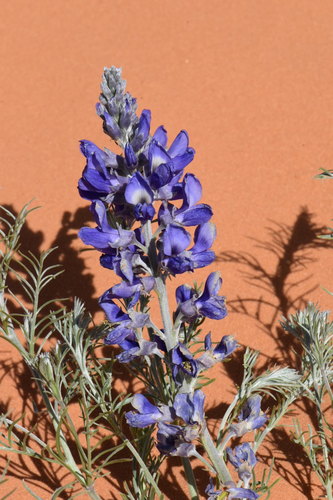
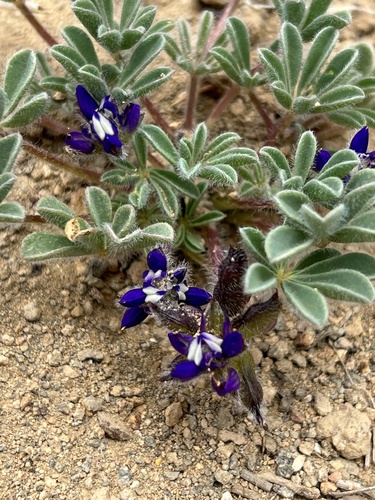
Lupinus brevicaulis S.Watson is a hairy annual herb that grows from a taproot, with no true visible stems and a low, spreading, nearly flat growth form. It reaches an overall height of 5 to 10 centimeters, with its stem only a few centimeters long. All leaves are arranged in a basal tuft that encircles the base of the plant, each leaf borne on a petiole 1 to 7 centimeters long. Each palmate leaf is composed of 5 to 8 leaflets, most often 6 to 8, that measure around 1 centimeter long and a few millimeters wide. The inflorescence is a small, dense, nearly spherical spiral cluster of flowers that measures about 2 centimeters long, held above the basal leaf rosette on a peduncle that can reach up to 6 centimeters long. Flowering begins when the peduncle is still very short. Each individual flower is 6 to 8 millimeters long, most commonly bright blue or purple-blue, though occasionally white, and typically bears a white or yellowish spot on its banner petal. The fruit is a hairy legume pod around 1 centimeter long that holds 1 to 2 bean-shaped seeds. This species usually flowers in May and June. Its cotyledons are light green, round, and persist through growth. Young Lupinus brevicaulis is very difficult to distinguish from Lupinus kingii, but mature L. kingii is larger than L. brevicaulis in all features. L. brevicaulis can also be told apart from L. kingii by its lack of a visible stem and by the length of its calyx lips. Crushed leaves of this species are used as a liniment applied to boils, and it is also used to treat sterility.