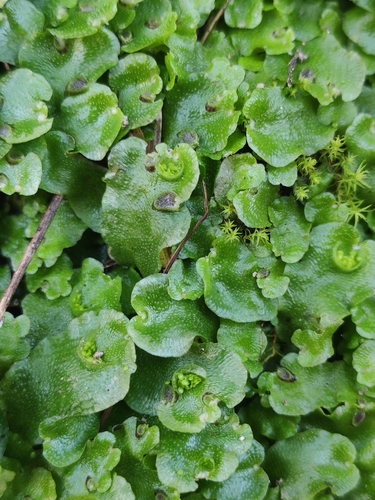
About Lunularia cruciata (L.) Dumort. ex Lindb.
Lunularia cruciata produces large, dichotomously branched green thalli with crescent-shaped gemma cups that hold disc-like gemmae. This crescent cup feature is a unique morphological trait that no other thalloid liverworts have. The surface of its thallus is shiny, faintly lined, and dotted with tiny air pores. When dried, the thallus becomes yellowish and its margin rolls inward. Like other liverworts, the main plant body (the thallus) is a haploid gametophyte. For L. cruciata, antheridia develop in early spring, archegonia develop in spring, and sporophytes develop in late summer. However, recorded instances of sporophyte development and sexual reproduction are rare and scattered. This pattern is suspected to be caused by anthropogenic spreading of the species, which leads to a disjunctive distribution of antheridia and archegonia. When reproducing sexually, four archegonia are arranged in a cross-shaped head (this arrangement is the origin of the specific epithet cruciata), and this head bears diploid sporophyte plantlets. When reproducing asexually, disc-shaped gemmae are easily dislodged from the gemma cups by splashes of rainwater. The dislodged gemmae can quickly take root and grow in suitably damp locations, which explains why the species is so successful in greenhouses. Lunularia cruciata has a worldwide distribution, occurring across the continents of Europe, Australasia, Asia, the Americas, and Africa. It is common in western Europe, and native to the Mediterranean region, where morphological forms resulting from sexual reproduction are found more frequently. It is also common in California, where it now grows wild, and is known as an introduced weed in gardens and greenhouses in Australia. Ella Orr Campbell believed L. cruciata was introduced to New Zealand sometime after 1867. While sporophytes of L. cruciata are rare overall, they have been recorded in European regions, as well as in South Africa, Argentina, California, India, Japan, and New Zealand. Lunularia cruciata grows in damp, shaded, disturbed habitats such as path edges and wall edges. It can act as a nutrient indicator, because it often grows in alkaline and eutrophic to highly eutrophic soil. Other common habitats include loam, boulders, concrete, exposed tree roots, soil-covered logs, and gaps between sidewalk stones. L. cruciata also grows as a horticultural weed in gardens, greenhouses, and parks. It is sensitive to frost, and is often found near water, where its gemmae are washed ashore.

