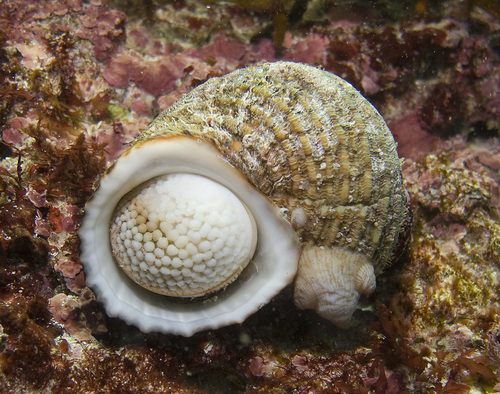
About Lunella coronata (Gmelin, 1791)
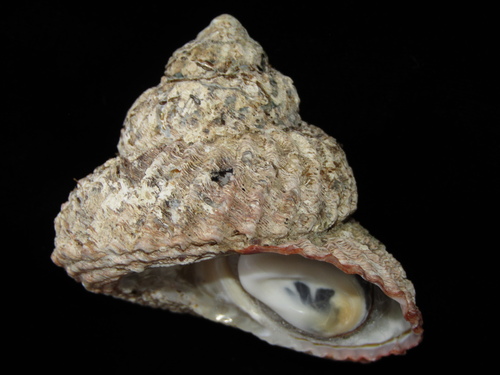
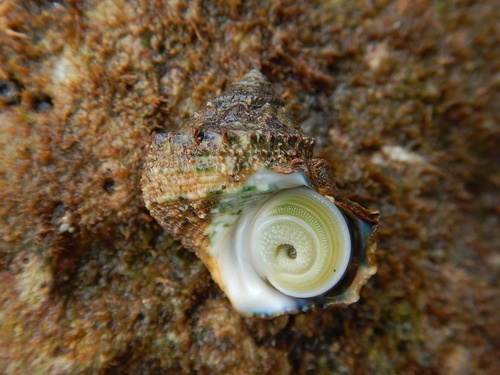
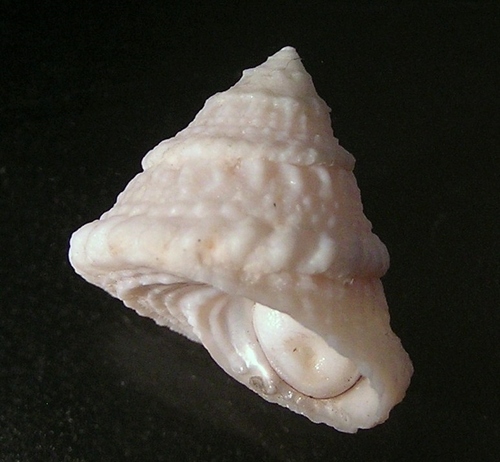
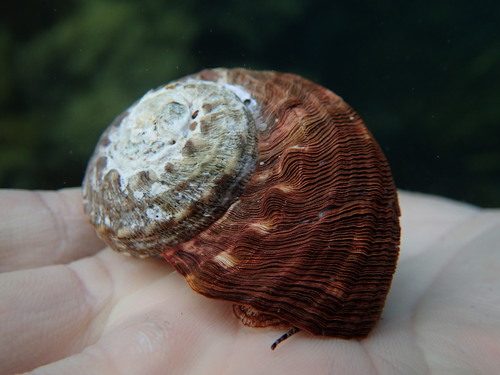
The shell of Lunella coronata reaches a maximum length of 4 cm. It has conspicuous flattened, cup-like scales interspersed with small, regular rows of nodules. Shell color ranges from pale to greenish, marked with flecks of purplish-brown, and the shell is often encrusted with light pink coralline algae. The operculum is smooth to faintly granular, with a pale green centre. The shell is solid and imperforate, with a depressed-turbinate shape where its diameter is greater than its height. It is covered by an irregular spiral series of nodules and granules; the subsutural series and two series on the median portion of the body whorl are more prominent. The spire is depressed and dome-shaped, with an apex that is frequently eroded and red. The shell holds 4 to 5 whorls, with the last whorl being very large. The large aperture is round and iridescent on the inside. The wide columella is flattened and excavated, deflexed, recurved, and somewhat channelled at its base. The inside of the operculum is flat, greenish and golden, and iridescent, with around 5–6 whorls and a subcentral nucleus. The outside of the operculum is convex, greenish, and sparsely granulate across its entire surface. This species displays a wide range of morphological variation. The transition from strongly tuberculate forms to forms where transverse striae simply cut lirae into diamonds or granules occurs through imperceptible degrees. This species inhabits the upper eulittoral zone, where it lives in pools or under stones. This marine species is found in the Red Sea, off the coast of Southeast Africa, in the Mascarene Basin, and throughout the Indo-Pacific.