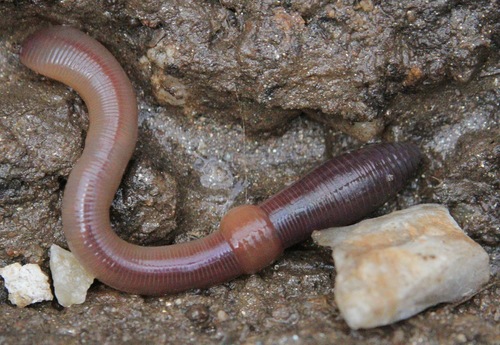
About Lumbricus terrestris Linnaeus, 1758
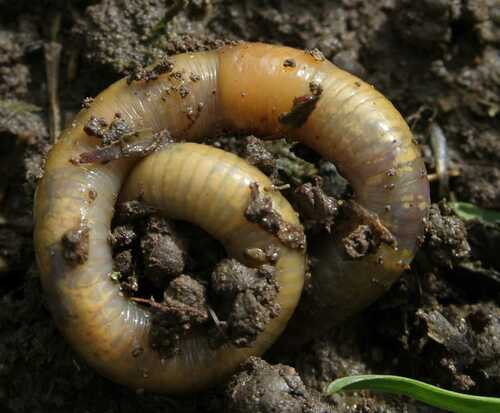
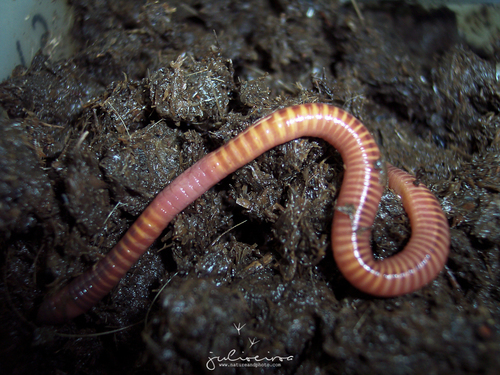
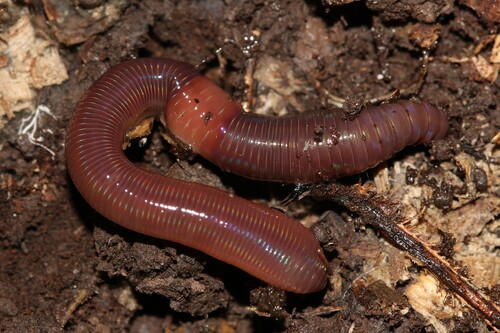
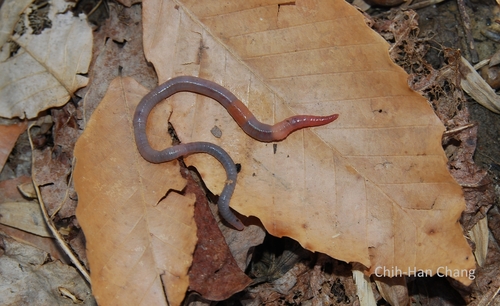
Lumbricus terrestris Linnaeus, 1758 is a relatively large earthworm, pinkish to reddish-brown in colour. Adults are generally 110–200 millimetres (4.3–7.9 in) long and around 7–10 millimetres (0.28–0.39 in) in diameter. It has between 120 and 170 body segments, most often 135 to 150. Its body is cylindrical in cross section, except for a broad, flattened posterior section. The head end has dark brown to reddish brown lateral and dorsal pigmentation, which fades towards the back of the body. This species has a hydrostatic skeleton, and moves by contracting longitudinal and circular muscles. Tiny hair-like projections called setae use slime to gain leverage against surrounding soil. On moist, flat terrain, the species has been recorded moving across the surface at 20 meters per hour. Measurements of foraging trails estimate that L. terrestris can travel up to 19 meters away from its burrow during a single nocturnal surface foray. Visible surface movement is most common during and after heavy rainfall, when people often notice large numbers of these earthworms, for example in urban ecosystems. This movement is often assumed to be a way to escape flooded, waterlogged burrows, but this explanation does not hold: L. terrestris, like other earthworms, can survive in oxygenated water for weeks at a time. Under less severe conditions where air temperature and moisture are sufficient, the worm will regularly move across the surface. This surface activity may be driven by resource availability, or a drive to avoid mating with close relatives. Lumbricus terrestris is a deep-burrowing anecic earthworm, meaning it builds deep vertical burrows and comes to the surface to feed, unlike endogeic species that burrow through soil to find food. It removes plant litter from the soil surface, pulls it down into the mineral soil layer, and deposits casts of mixed organic and mineral material on the soil surface. In areas with classic podzol profile development that this species has invaded, it has destroyed the soil’s original distinctive banded appearance, which consisted of a thick dark organic litter layer on the surface, underlain by a pale E horizon, and a brown or reddish B horizon below that. It produces a new soil horizon sequence: thin litter over a dark Ap mixing zone created by the worms’ activity, which sits above the original B horizon. L. terrestris lives in semi-permanent burrows and can reside in or escape to deeper soil layers. Its activity is limited by both temperature and humidity. High soil and night air temperatures inhibit activity, as do low night moisture and dry soil. During these limiting conditions, particularly in summer, the worms retreat to the deepest sections of their burrows. Winter temperatures can also reduce activity, though the species can remain active through winter in maritime climates. This earthworm strongly influences soil fungi, and creates distinct micro-habitats called middens that heavily affect the spatial distribution of plant litter and litter-dwelling animals on the soil surface. In the soil system, L. terrestris worm casts are associated with benefits to plants, visible in scenarios including plant propagation from seed or clone. Compared to soil without worm casts, worm casts promote root development, increase root biomass, and raise the overall proportion of root material in the soil. In parts of Europe, especially the Atlantic fringe of northwestern Europe, L. terrestris is now locally endangered. This is due to predation by two introduced predatory flatworms: the New Zealand flatworm Arthurdendyus triangulatus and the Australian flatworm Australoplana sanguinea, both accidentally brought to Europe from their native ranges. These flatworms are very efficient predators of earthworms, and can survive for long periods without food. This allows them to persist in an area even after their earthworm prey populations drop to unsustainably low levels. In some affected areas, this decline of L. terrestris has had a serious negative impact on soil structure and quality. In some places, the soil aeration and organic material mixing previously performed by these earthworms has stopped entirely. Lumbricus terrestris is an obligately biparental, simultaneous hermaphrodite, and reproduces sexually by mutually exchanging sperm between mating individuals. Copulation occurs on the soil surface, but both mating partners remain anchored in their own burrows. Mating is preceded by repeated mutual visits to each other’s burrows between neighboring individuals. When mating partners separate, one individual may be pulled out of its burrow. Mating occurs relatively frequently, once every 7 to 11 days. Key factors shaping the species’ mating behavior include the relative size of potential mates, distance from potential mates, the chance of being dragged to the surface, and size-related fecundity. Sperm can be stored for up to 8 months, and mated individuals can produce cocoons for up to 12 months after mating. Fertilization occurs inside the cocoon, and the cocoon is deposited in a small soil chamber adjacent to the parental burrow. Young worms emerge after a few weeks and begin feeding in the soil. Early juvenile worms do not dig the vertical burrows that are typical of adult individuals. Adulthood likely requires a minimum of one year of development, with reproductive maturity reached in the second year. The natural lifespan of wild L. terrestris is unknown, though captive individuals have been recorded living for six years.