About Lullula arborea (Linnaeus, 1758)
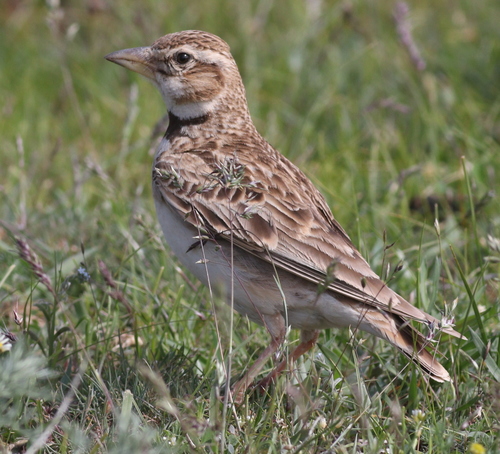
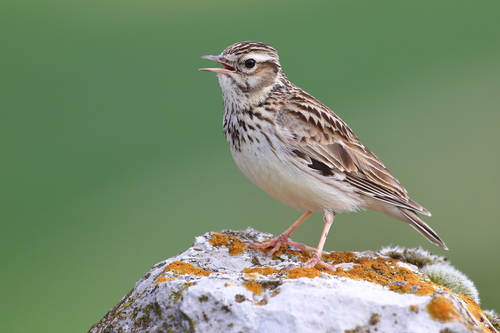
The woodlark, Lullula arborea (Linnaeus, 1758), is a songbird measuring 13.5 to 15 cm in length, roughly 20% shorter and slightly smaller than the skylark. Its upperparts are mainly brown, and its underparts are pale, with a distinctive white superciliar that meets on the nape. It has a small crest that is inconspicuous most of the time. In flight, it has a short tail and short, broad wings. The tail is tipped with white, but unlike the skylark, the tail sides and rear edge of the wings do not have white edges. The woodlark has a melodious, warbling song, often described onomatopoeically as lu-lu-lu- or more precisely as "serial lū-lū-lū-lū-lū-, toolooeet toolooeet toolooeet".
Woodlarks are found mainly across Europe, the mountains of northern Africa, and western Asia. The species' range extends from England in the west, the Scandinavian Peninsula in the north, parts of northern Egypt to the south, and Iran and Turkmenistan to the east. It is present across much of this range, but declining populations have led to range contraction; for example, it once bred in Wales and central England, but now only occurs in southern England. Within its range, western populations are mainly resident, while eastern populations migrate south for winter.
In 1988, population density surveys recorded 7.5 pairs per square kilometre on the sandy heaths of Belgium, where the species is most at home. In the same year, densities ranged from 0.29 to 5.0 pairs per km2 in East Germany, and 0.1 to 0.25 pairs per km2 in southern England, with higher densities in more optimal habitats. Populations fluctuated across Europe in the 1990s and 2000s, and no more recent density figures are available.
The woodlark's natural habitat is heathland and open spaces with sparse tree cover. It prefers clearings in pine forests, heathland, and newly planted areas with pine saplings. Experimental work has shown that annual ground disturbance can increase woodlark abundance in lowland grass-heaths. The species is rarely found in urban areas; for example, a pair was recorded on a main road near Putney Heath, London in 1950.
Male woodlarks have a song flight similar to that of the Eurasian skylark, but they flitter more as they rise and spiral upward, circling the ground while singing at a fairly constant height. Both males and females also sing from the ground or a perch. In Britain, singing begins early in the season, usually around February.
Like many other lark species, adult woodlarks are primarily vegetarian, but they also eat medium-sized insects during the breeding season. Their diet is mostly made up of seeds and insects including beetles, flies, and moths. During the breeding season, females incubate eggs in stints of approximately 45 minutes, with 8-minute feeding intervals between incubation spells.