About Luidia senegalensis (Lamarck, 1816)
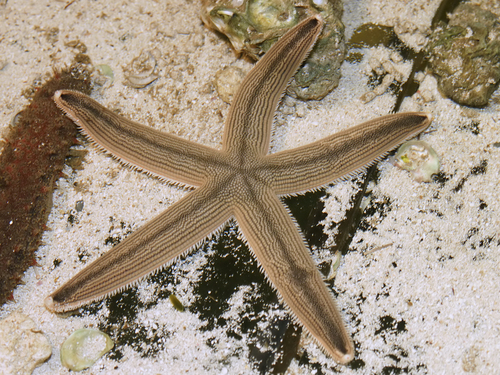
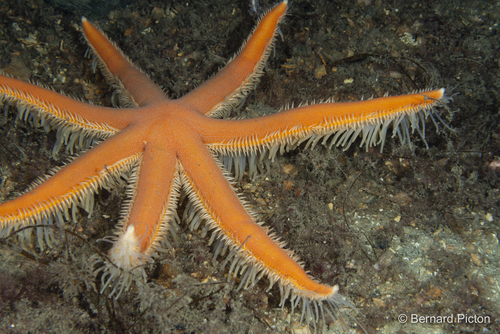
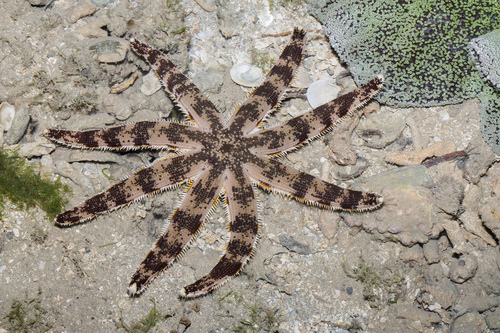
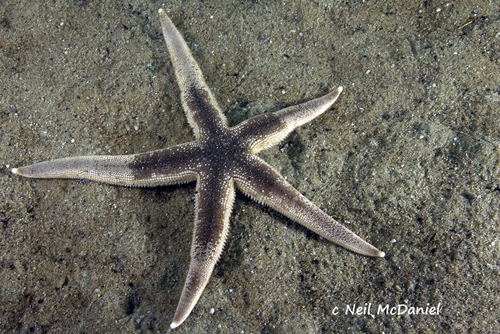
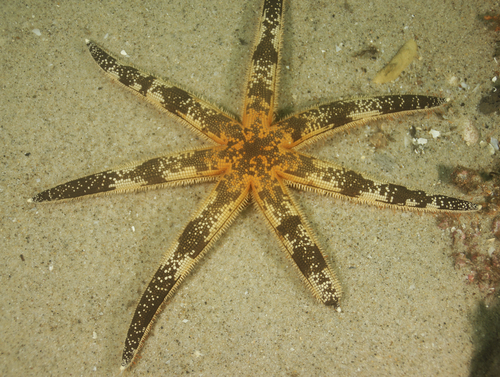
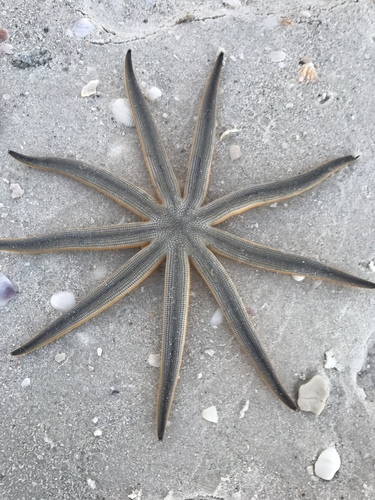
Description: The nine-armed sea star (Luidia senegalensis) has long, slim, tapering arms attached to a small circular central disc. It reaches a diameter of about 30 to 40 centimetres (12 to 16 inches). The aboral (upper) surface is covered in a patchwork of closely packed spiny plates. Square plates near the edge of the arms are cream-coloured, while irregular plates in a band running down the middle of the arms are grey. The arm margins are fringed with short white spines. The oral (underside) of the sea star has additional small white spiny plates along the edges of the arms, and a central band of translucent, orange tube feet. Like other species in its genus, it has tube feet that lack suckers. The mouth is located at the centre of the disc, and there is no anus, so undigested food fragments are expelled through the mouth. Distribution and habitat: The nine-armed sea star occurs at depths up to 40 metres (130 ft). It is found around the coasts of Florida, in the Caribbean Sea, the Gulf of Mexico, and along the coast of South America as far south as southern Brazil. It prefers sandy, muddy, or shelly seabeds in sheltered locations such as lagoons. It shares the same geographic range as the closely related gray sea star (Luidia clathrata) and has very similar colouring, but can be easily distinguished by its number of arms. Luidia clathrata has five arms while this species has nine.