About Luidia maculata Müller & Troschel, 1842
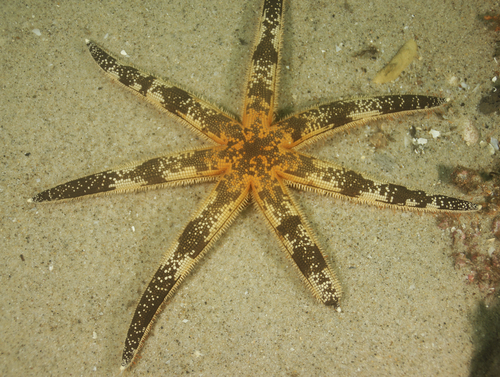
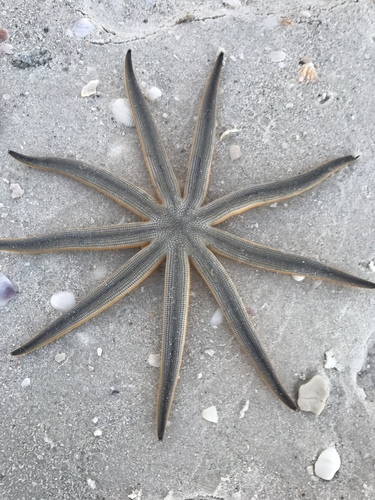
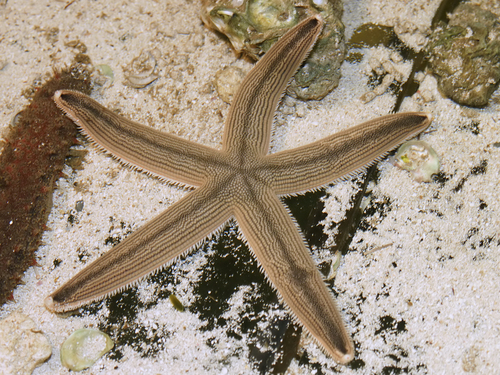
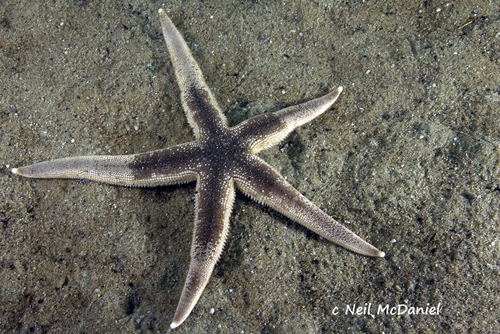
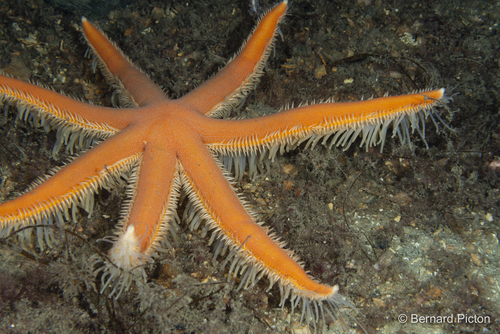
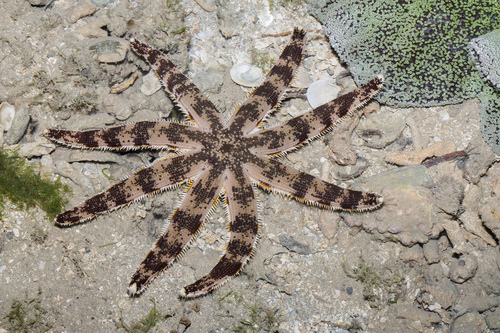
Luidia maculata is a large starfish, reaching up to 25 cm (10 in) in diameter. It usually has seven or eight, sometimes nine, long, slender, pointed arms attached to a relatively small central disc. Its aboral (upper) surface is flat with slight granulation, and is covered in flat-topped, table-like structures called paxillae. Rows of pale tube feet, which end in points rather than suction pads, are visible on the sides of the arms and the oral (lower) surface. There are two distinct colour forms of this species: some individuals are a uniform dark brown or greenish-brown, while others are dark brown with orange-brown chevron-shaped markings, or light brown with dark markings. This starfish can be confused with other species in the Luidia genus, especially L. savignyi; however, L. savignyi is spiny, while L. maculata is smooth. Another similar species is L. magnifica, which typically has nine or ten arms, unlike L. maculata.
Luidia maculata is native to the tropical Indian and Pacific Ocean. Its most common habitat is muddy sediment on lagoon floors, but it can also be found in other soft sediments and seagrass beds. It occurs at depths ranging from a few metres down to approximately 35 m (115 ft).
Luidia maculata partially buries itself in soft sediment, making it difficult to spot. It is a predatory species that feeds mostly on sea urchins, particularly irregular sand dollars and other burrowing echinoderms that also live buried in sand. Unlike some related starfish species that use external digestion, L. maculata draws its whole prey into its mouth to consume it. When it leaves its hiding spot, it often leaves behind inedible fragments of its prey’s tests in the hollow it vacated. Other food sources include sea cucumbers, brittle stars, bivalves, snails, crustaceans, and worms. Luidia maculata ingests its prey through the oral opening located at the center of the disc, on its ventral surface, and digests it inside its body, unlike starfish that practice extra-oral digestion.