About Luidia foliolata Grube, 1866
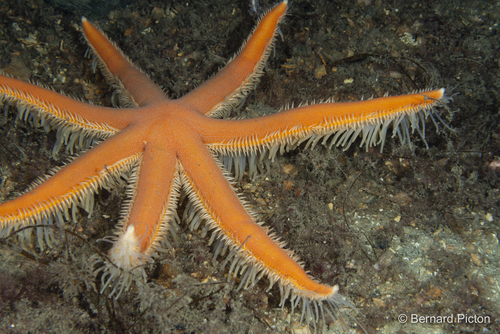
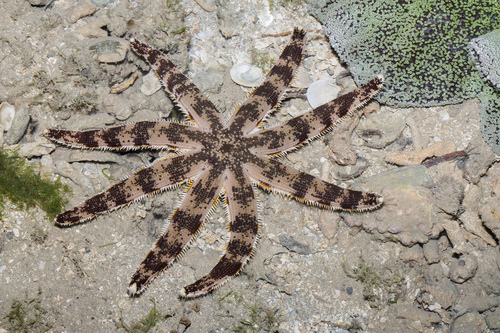
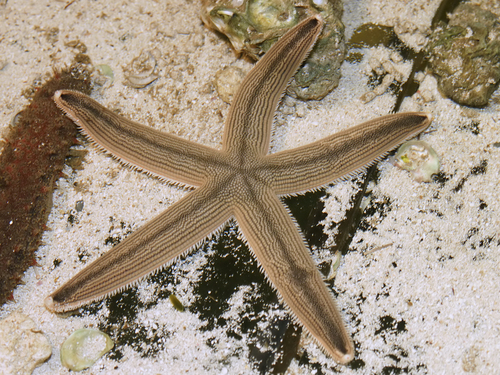
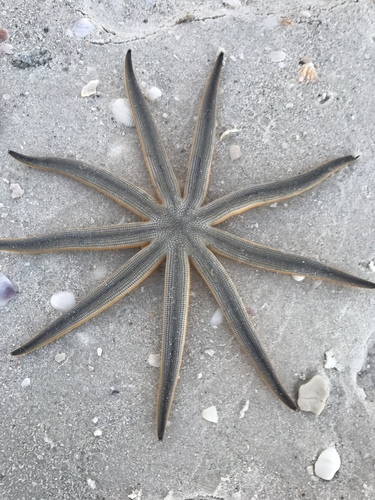
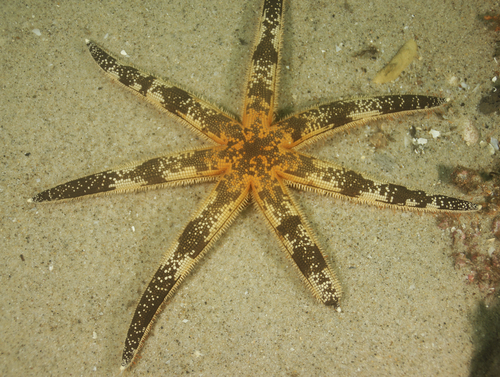
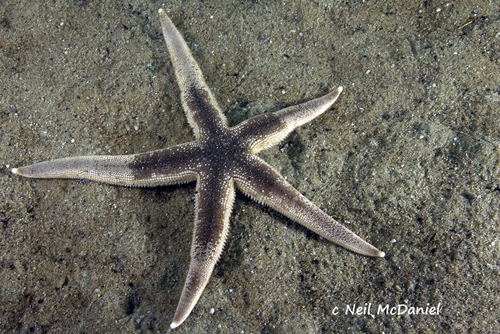
This species, commonly called the sand star, has a small central disc and five long, flattened arms that end in tapering tips. It can reach a total diameter of 40 cm (16 in), and its body colour is grey, greenish-grey, or pale brown, sometimes marked with white speckles. The arms bear rows of large marginal plates, each of which has several spines, but these plates cannot be seen from the aboral (upper) side of the animal. Its tube feet do not have suckers, and instead end in blunt points. The sand star can be easily mistaken for Astropecten verrilli, but in A. verrilli the large marginal plates are visible from above. This starfish is easily damaged; it often breaks into pieces when lifted from the seabed by trawling. Even when specimens are brought to the surface intact, they often have missing or regenerating arms, which may be caused by attacks from predatory crabs or fish. The sand star occurs on soft substrates in the northeastern Pacific Ocean, at depths down to 600 m (2,000 ft). Its range extends from Alaska to Nicaragua and the Galapagos Islands.