About Luidia clathrata (Say, 1825)
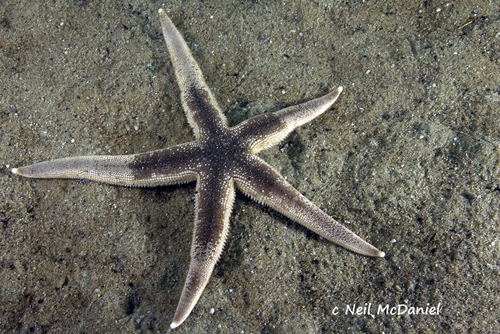
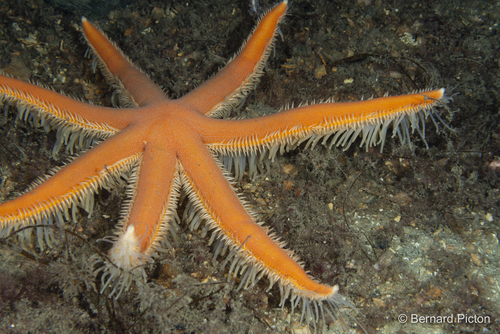
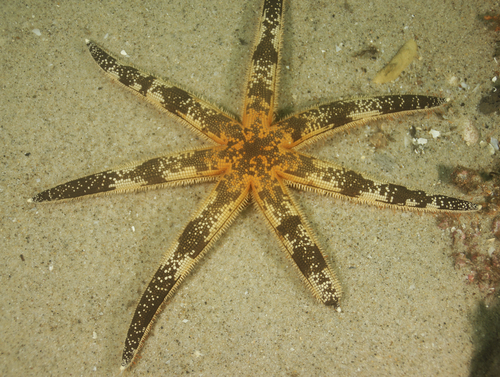
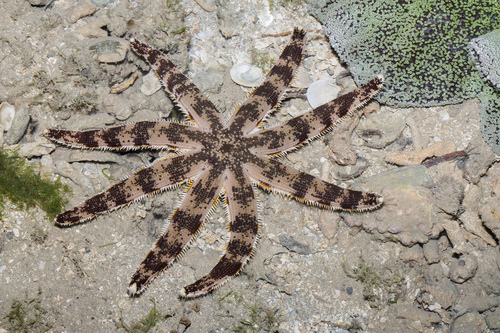
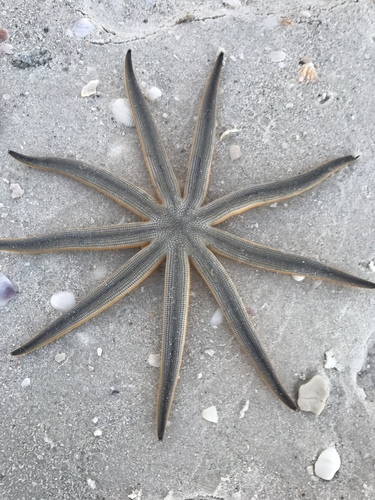
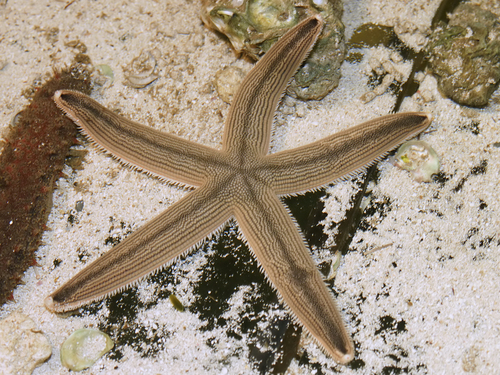
Luidia clathrata (Say, 1825) is a large, somewhat flattened starfish that can grow up to 30 cm (12 in) in diameter. It has a comparatively small central disc and five slender arms, each two to three times as long as the disc’s diameter. The upper surface of the disc and arms is covered in longitudinal rows of calcified plates called ossicles, plus paxillae—pillar-like spines with flat tops covered in tiny spinules. The margins of the arms have no plates on the upper side, and are instead covered by paxillae; on the underside of the arms, the marginal plates are large and are themselves covered in paxillae. The tube feet, arranged in longitudinal rows on the starfish’s underside, lack suckers but have two swollen sections. A mouth sits at the center of the underside, alongside an oesophagus and a cardiac stomach that can be turned inside out, or everted. Gonads are located under the sides of each arm. Its base color is usually grey or light brown, sometimes with a pink tinge. The central row of plates on the upper side of each arm is typically dark grey or black, and the underside of the starfish is a paler shade than the upper surface. L. clathrata occurs along coastlines of the western Atlantic Ocean, ranging from Virginia southwards to Brazil, and is also found in the Caribbean Sea and the Gulf of Mexico. It most commonly inhabits sandy or muddy seabeds at depths down to around 40 m (130 ft), though it is occasionally found in deeper waters as far down as 100 m (330 ft). If L. clathrata loses part or all of an arm to predation, it can fully regenerate the lost limb. The damaged area is first sealed off, and a small new arm tip appears within one week. After that, new growth proceeds at a rate of roughly 3.7 mm (0.15 in) per month, with growth slowing as regeneration nears completion. A study of the species’ regenerative ability found that increased ocean acidification, the projected outcome of global warming, has no significant impact on this starfish’s capacity to regenerate lost limbs. L. clathrata acts as both a predator and a general forager. When the small bivalve Mulinia lateralis, commonly called the coot clam, is abundant, L. clathrata feeds selectively on this prey, using chemoreceptors to locate it. Coot clams are the confirmed preferred prey of L. clathrata in Florida’s Tampa Bay. When coot clams are not abundant, the starfish feeds by swallowing sediment and straining the material through spines surrounding its mouth to remove usable food particles. Its broader diet includes gastropod and bivalve molluscs, foraminiferans, nematodes, ostracods, small crustaceans, and detritus. The species is photosensitive and spends most daylight hours buried in sediment; while buried, it will sometimes evert its stomach to consume detritus. L. clathrata spawns once each year. Its larvae go through a planktonic bipinnaria stage that lasts around one month, after which the larvae settle on the seabed, undergo metamorphosis, and develop into juvenile starfish.