About Luidia ciliaris (Philippi, 1837)
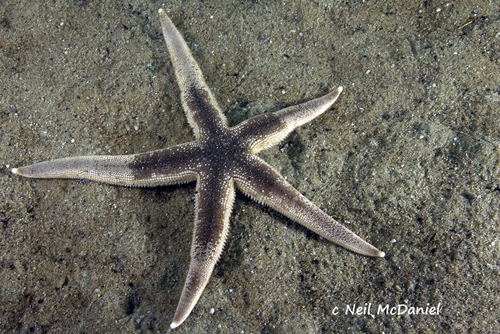
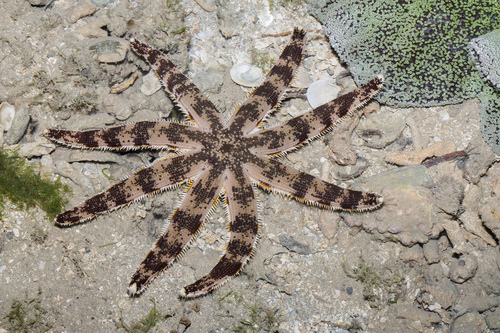
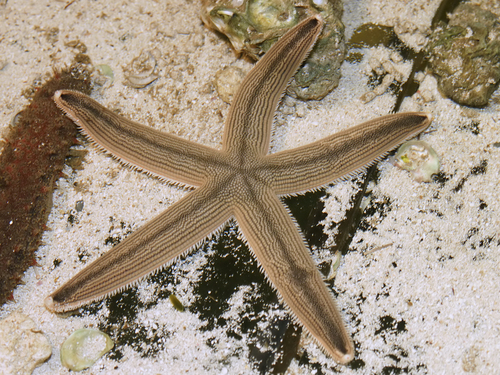
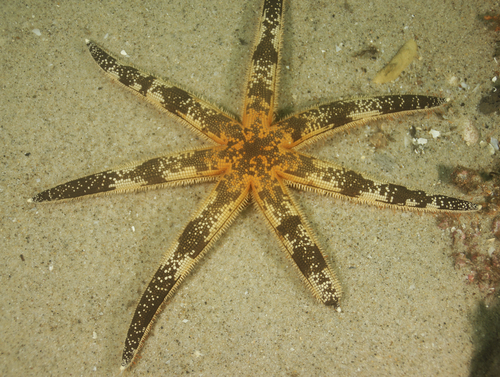
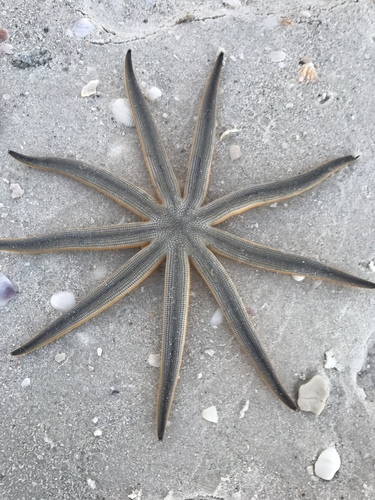
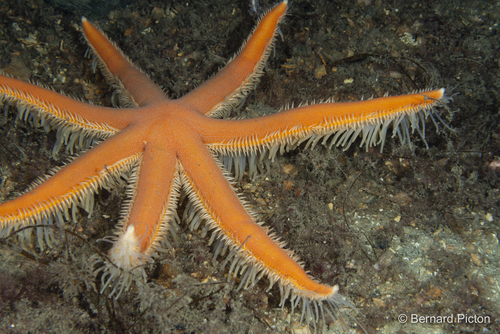
Luidia ciliaris, commonly known as the seven-armed starfish, is orangeish-brown in color, with seven long arms that radiate out from a small central disk. This is a large but fragile sea star that can grow to 40 cm (16 in) across. It easily loses its arms, and lost arms are later regenerated. The arms have parallel sides and only taper near the tip. A conspicuous fringe of white spines runs along the margins of the arms. The upper surface of the sea star is covered in paxillae, which are spines shaped like pillars with a flat top that bears tiny spinules. Many-lobed, nipple-like papillae are also present on the upper surface. There are no marginal plates on the upper side of the arms, but the marginal plates on the lower side of the arms bear two-valved pedicellariae. The tube feet are long and numerous; they do not have suction pads, but do have two sets of terminal bulbs. The gonads are arranged in two rows along the length of each arm. A mouth is located at the center of the underside, along with an oesophagus and a cardiac stomach. This species has no intestine, pyloric stomach, or anus. Luidia ciliaris lives on the seabed in the eastern Atlantic Ocean, ranging from Norway and the Faroe Islands southwards to Cape Verde and the Azores. It is also found in the Mediterranean Sea. It occurs in the neritic zone at depths down to 400 m (1,300 ft), and is found mainly on soft sediments into which it sometimes burrows. It may also occasionally be found on rock.