About Ludwigia peploides (Kunth) P.H.Raven
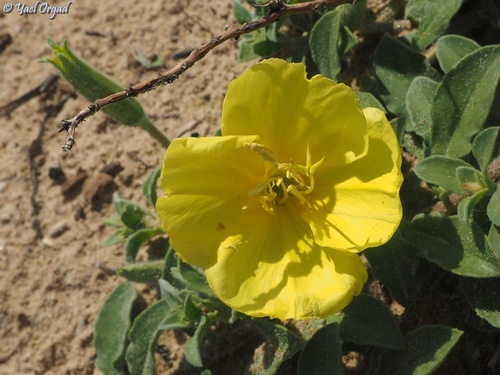
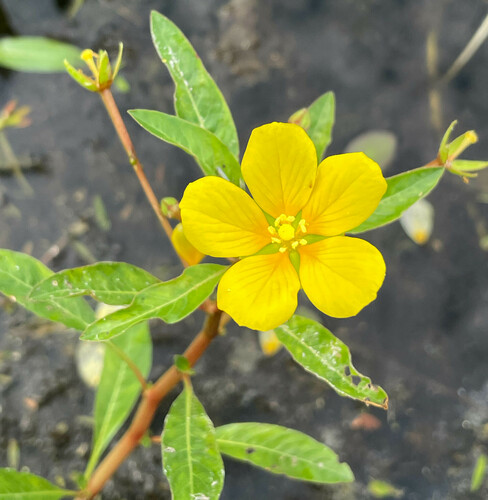
Ludwigia peploides (Kunth) P.H.Raven is an herbaceous perennial wetland plant that typically grows along mud flats or water surfaces, sprawling flat across these substrates. It is very similar to Ludwigia hexapetala and difficult to distinguish from that species. Its leaves are arranged in clusters and vary in size, with an average length of approximately 3.5 inches. Leaves range from egg-shaped to lance-shaped, are hairless, and each leaf base tapers to a stalk between 1 and 1.5 inches long. Stems can grow up to 9 feet long, may be hairless or slightly hairy, and always have a fleshy texture. Ludwigia peploides is native to Australia, North America, and South America. The entire Ludwigia genus occurs worldwide, with a total of 82 species divided into 23 sections. Ludwigia species can be woody, herbaceous, or aquatic, and have high reproductive rates and efficient dispersal capacity that help them invade habitats across the globe. Their reproductive cycle follows four seasonal stages. In spring, new shoots develop buds; shoots grow erect in shallow water, and adopt a creeping growth form in drained environments. Stems eventually reach the water surface, where they form rosettes and small round leaves. In summer, apical growth and new branches develop regardless of whether the plant grows erect or creeping. Flowers begin to emerge after the plant reaches an overall lateral extension of 50 centimeters. Yellow flowers are produced from late June to early October, when sexual reproduction takes place. Sexual reproduction in this species is poorly understood due to limited research, and it varies between Ludwigia species. Fruiting occurs in autumn, from August to November. In winter, most plants break apart, dry out, and decay, though some individuals can survive the season. Ludwigia species can propagate from stem fragments or rhizomes broken off by wind, water flow, or animals, which has allowed the genus to spread across the globe. Fragments of Ludwigia peploides can double their biomass between 15 and 90 days, letting the species thrive even in habitats where sexual reproduction cannot occur. Ludwigia species grow predominantly in wetlands and in transition zones between aquatic and terrestrial environments. Due to high phenotypic plasticity, they can colonize a wide range of areas including slow-flowing waters, river banks, and wet meadows. They prefer slow-flowing water over high-velocity water, and most Ludwigia species grow in stagnant water between 0.06 and 1 meter deep. Greater water depth restricts development, but shoots can still form flower buds. In low-nutrient conditions, Ludwigia doubles its biomass. Intense water salinity is the only known major limitation for the species. Ludwigia peploides is not commonly eaten by humans, and was originally traded for ornamental purposes. It is both melliferous and polliniferous. Ludwigia species produce numerous compounds with medicinal properties, including saponins, tannins, polyphenols, alkaloids, linoleic acids, flavonoids, starch grains, and calcium oxalate crystals. Three of these compounds contribute to antioxidant activity. There is also potential use of the species for agricultural wastewater management, because the plant can accumulate high concentrations of nitrogen and reduce ammonia and nitrate levels in soil. All these uses remain purely potential, as there has been almost no investigation into practical applications of Ludwigia peploides. Further research is required to harness its potential medicinal and agricultural benefits.