About Ludwigia palustris (L.) Elliott
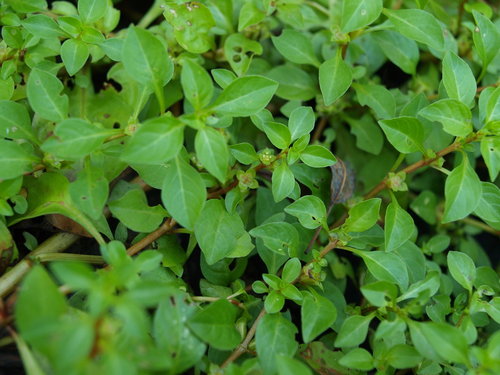
Ludwigia palustris (L.) Elliott forms prostrate, sprawling mats in wet, disturbed areas. Its stems are semi-succulent, reddish, and either smooth or slightly hairy. As stems spread along the ground, roots grow from the stem nodes. Mature stems can reach 10 to 40 centimeters in length. Its leaves are arranged oppositely along stems, are smooth, oval-shaped, and grow up to 4 centimeters long. Leaves have winged petioles and are often reddish-green. Greenish-white flowers grow from leaf axils, reach 2 to 3 millimeters long, and lack petals. Each flower is made up of 4 triangular sepals and 4 white-tipped stamens, positioned above a cube-shaped, 4-angled ovary. The fruits are small, cube-shaped capsules 2 to 3 millimeters long, pale green with darker green stripes along their angles. The sepals persist and remain attached to fully developed fruits. Ludwigia palustris is a circumpolar species with a large native range that covers North America, South America, Africa, Asia, and Europe. It occurs as a naturalized or invasive species in Hawaii, Australia, and New Zealand. The species is generally restricted to low elevations, where it grows in shallow water environments including reservoirs, ditches, and the banks of ponds, rivers, and streams. It requires wet, muddy or sandy soils that are low in calcium but rich in humus and nutrients. Ludwigia palustris is cultivated for use in aquariums and aquascaping. It is often sold in the trade under the common cultivar names Ludwigia 'super red', Ludwigia 'mini super red', or Ludwigia 'red'.