About Luciola cruciata Motschulsky, 1854
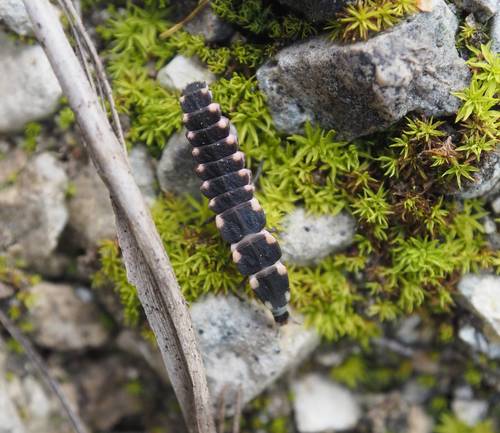
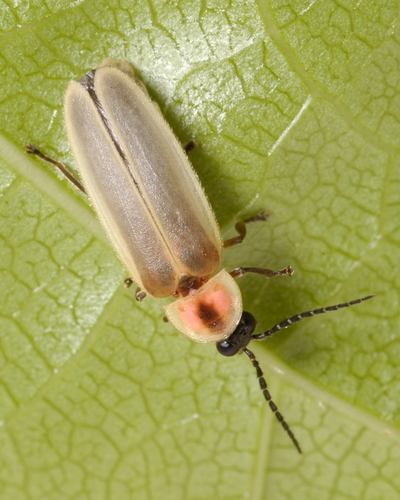
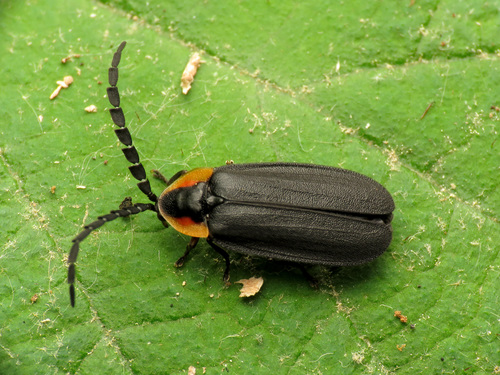
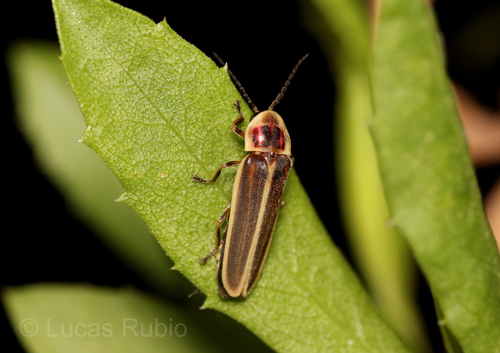
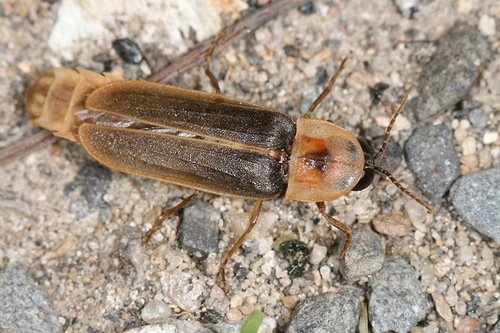
Luciola cruciata is sexually dimorphic in size: males measure 10.5–16.5 mm (0.41–0.65 in) in length and 3.0–5.0 mm (0.12–0.20 in) in width, while larger females measure 15.0–18.6 mm (0.59–0.73 in) in length and 5.0–6.0 mm (0.20–0.24 in) in width. Its pronotum is reddish pink with a central marking, and the elytra are black and elongate. Male venters are brown and pale yellow; female venters are brown, yellow, and reddish pink. The male's luminous organ occupies the sixth ventrite. Antennae, which are approximately 6 mm (0.24 in) long, are positioned between well-developed eyes. Luciola cruciata larvae have soft bodies with gills, and possess eversible (can be turned inside out) defensive organs.
This species is found throughout Japan, excluding Hokkaido and Okinawa. There is one unconfirmed record of the species from Korea. It inhabits small ditches and streams with mud or pebbles on the bottom. Adult Luciola cruciata can be found between May and July.
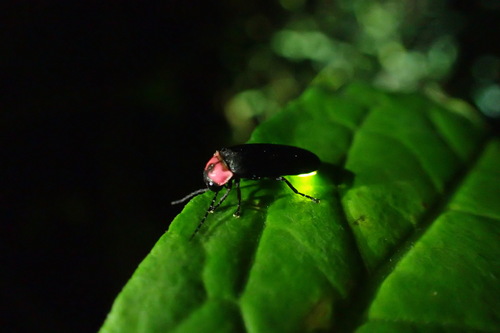
Larvae are aquatic, cannot swim, and crawl along stream and ditch bottoms. They prey on Semisulcospira libertina snails, and go through six to seven instars. Adult fireflies emerge from underground pupae around June. The species takes more than one year to reach maturity. Adults live for less than three weeks and do not feed. This species uses what is known as a "complex system" of flash communication. Flying males produce synchronized flashes, while females do not fly when flashing and their flashes are not synchronized. A male's flash pattern changes when it perches near a female that emits single pulses, after which the male approaches the female to copulate. In western Japan, male flashes have a two-second interval between them, while in northern Japan the interval is four seconds; three-second intervals occur in populations between these two regions. Females lay a total of 500–1000 eggs. In western Japan, females lay eggs in groups, while in eastern Japan females lay eggs solitarily.