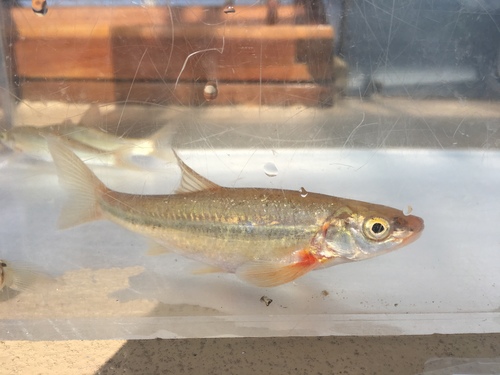
About Luciobarbus sclateri (Günther, 1868)
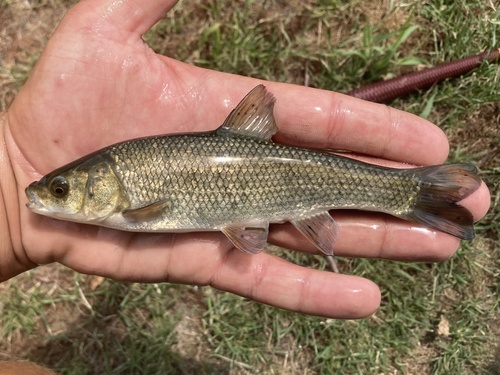
The Andalusian barbel, Luciobarbus sclateri, is also commonly called the gypsy barbel, a direct translation of its Spanish name Barbo gitano. It is a species of freshwater fish belonging to the family Cyprinidae. Following the IUCN classification, this species is placed in the genus Luciobarbus. However, this genus is very closely related to other typical barbels, and may be more appropriately considered just a subgenus of Barbus. The Andalusian barbel was formerly classified as a subspecies of L. bocagei. L. sclateri is endemic to the southern part of the Iberian Peninsula, and can be found in both Portugal and Spain. It inhabits the middle and lower sections of rivers, ranging between the drainage basins of the Segura River and the Mira River. It is not highly selective about its habitat, and will use most types of river habitat except for small, cool, torrential mountain streams. This species spawns at the start of summer, between May and June. Males reach sexual maturity at 2 to 4 years of age, at a length of around 8 cm (3.1 in). Females only reach sexual maturity in their sixth or seventh year, at a length between 11 and 16 cm (4.3 to 6.3 in). Andalusian barbel grow to a maximum length of approximately 50 cm (20 in). It is a long-lived species, with a maximum recorded age of 18 years. The Andalusian barbel is quite abundant, and is not classified as a threatened species by the IUCN. Even so, local populations may be completely wiped out during summer droughts, which isolate and dry up the small creeks the species inhabits. Existing habitat fragmentation that already impacts the species is made worse by these summer droughts.