About Luciobarbus bocagei (Steindachner, 1864)
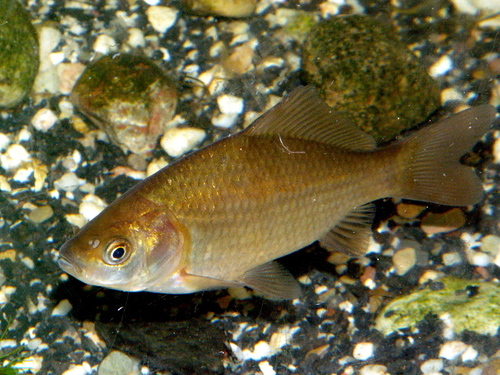
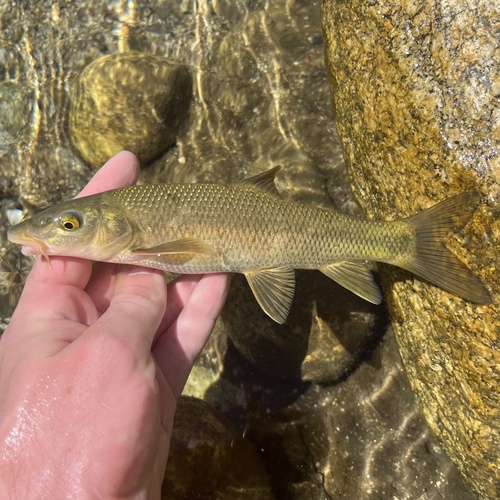
Luciobarbus bocagei (Steindachner, 1864) is a ray-finned fish species belonging to the Cyprinidae family. Its scientific name was named to honor Portuguese zoologist and politician Jose Vicente Barboza du Bocage. Following IUCN classification, this species is placed in the genus Luciobarbus. However, this genus is very closely related to other typical barbels, and many consider it better treated as just a subgenus of Barbus. The Ebro barbel (L. graellsii) and Andalusian barbel (L. sclateri) were formerly classified as subspecies of L. bocagei. Natural hybrids between this barbel and the closely related near-threatened Iberian Barbel (L. comizo) are fairly common in the middle Tagus river. The two parent species and their hybrids are difficult to tell apart, but L. bocagei has a shorter, wider head. Additionally, the last unbranched ray of its dorsal fin has a shorter denticulated section, but with more densely packed denticles. Hybrids are intermediate between the two parent species for the first two traits, and closer to L. comizo for the denticle trait. Where the two species occur together, they can also be distinguished by different microhabitat preferences: L. comizo lives in nearly stagnant sections of river. Hybridization between the two species interferes with phylogenetic studies that rely only on mtDNA data. L. bocagei is endemic to the Atlantic-facing portion of the Iberian Peninsula, where it is found in both Portugal and Spain. It lives in slow-moving middle and lower sections of rivers, ranging between the drainage basins of the Limia/Lima and Sado Rivers; this range includes basins such as the Douro and Tagus, for example. Although L. bocagei does not have an especially large range, it is quite abundant, and the IUCN lists it as a near-threatened species. Its diet consists mainly of benthic invertebrates and detritus. This species spawns from late spring to early summer, between May and June, in faster-moving water than it normally occupies. Males reach sexual maturity at 3 years of age, at a length of around 7 cm (2.8 in). Females take at least twice as long to mature; in some cases, females only reach maturity at 8 years of age, when they reach 20 cm (7.9 in) in length. L. bocagei is a long-lived species, and a maximum age of 14 years has been recorded.