About Lucilia sericata (Meigen, 1826)
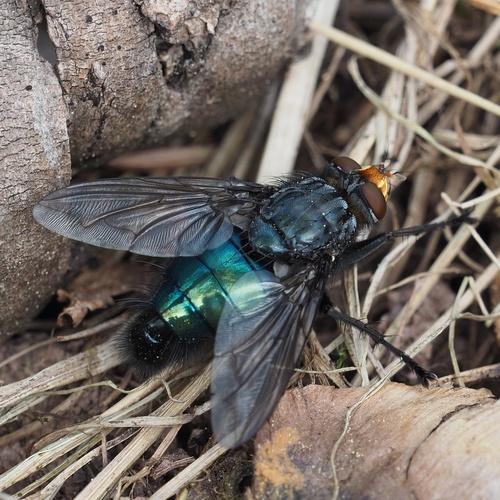
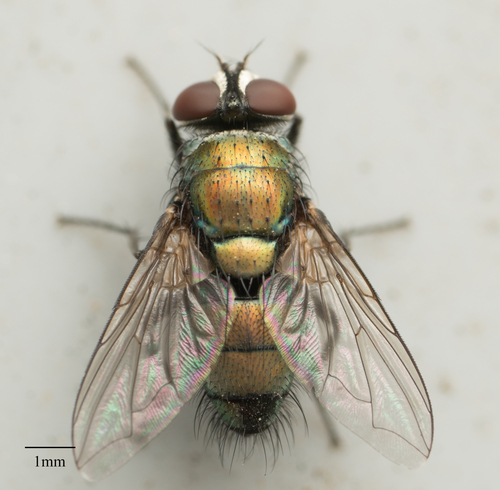
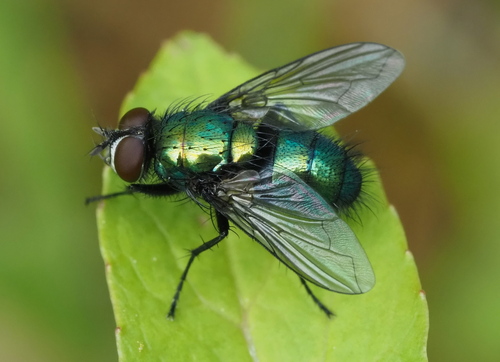
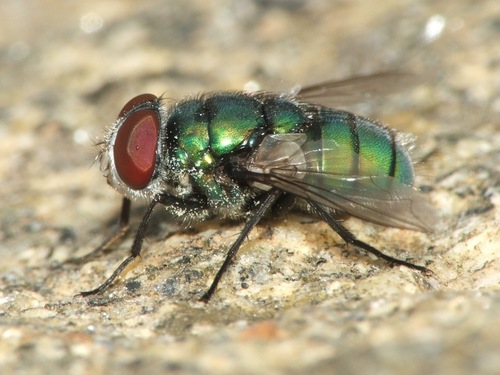
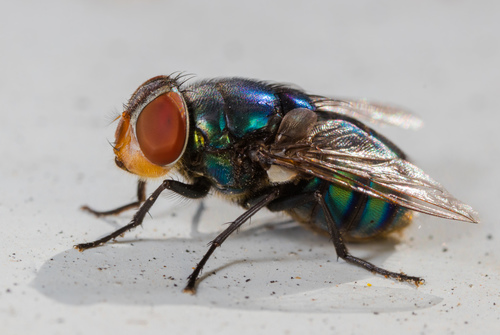
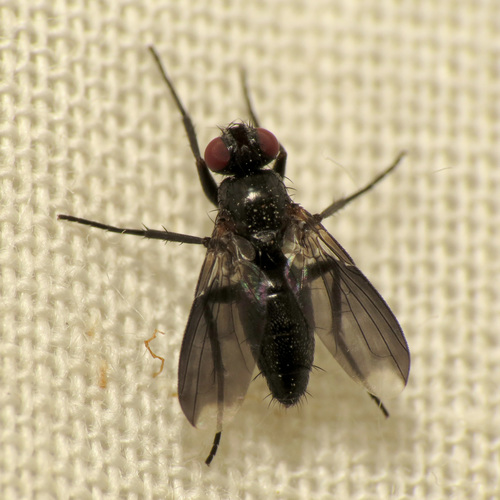
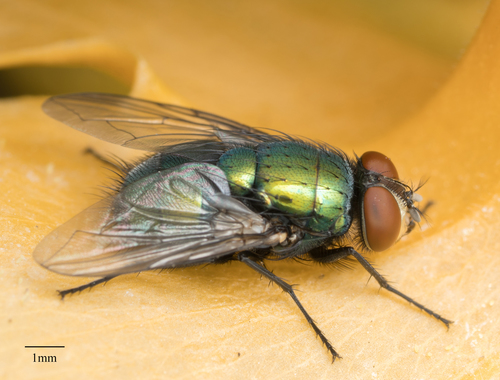
The key identifying feature of adult Lucilia sericata is three bristles on the dorsal mesothorax, located on the middle of the fly's back. L. sericata is nearly identical to its close relative L. cuprina, and distinguishing between the two requires microscopic examination of several main traits. L. sericata has a blue-black coloration, while L. cuprina has a metallic green femoral joint on its first pair of legs. For occipital setae, L. sericata has 1 to 9 bristles on each side, compared to 3 or fewer for L. cuprina. Additionally, L. sericata has smaller eyes and a thinner frontal stripe than L. cuprina.
Lucilia sericata is widespread across temperate and tropical regions worldwide, including Europe, Africa, and Australia. It favors warm, moist climates, making it especially common in coastal regions, though it can also occur in arid areas. Females lay their eggs on all types of carrion, and sometimes on the skin or hair of live animals, which causes myiasis. Its larvae feed on decaying organic tissue. L. sericata prefers hosts of the genus Ovis, particularly domestic sheep, and will sometimes lay eggs in the wet wool of living sheep. This activity can lead to blowfly strike, which creates problems for sheep farmers. Compared to other Calliphoridae species such as Calliphora vomitoria, L. sericata tends to prefer lower elevations.
The life cycle of L. sericata follows the typical pattern for flies in the Calliphoridae family. After a female deposits eggs, the eggs hatch into larvae that grow through three instars. Larvae then enter prepupal and pupal stages, which may finish development quickly or overwinter depending on temperature, before emerging as adult flies, also called imagos. Females lay clutches of eggs directly on carrion. Eggs hatch between 9 hours and 3 days after deposition; eggs laid in warmer weather hatch faster than those in cooler conditions. This differs from the more opportunistic Sarcophagidae, which lay already hatching eggs or fully hatched larvae in carrion, removing the waiting period for egg hatching. L. sericata is very prolific: a single female typically lays 150 to 200 eggs per clutch, and can produce 2,000 to 3,000 eggs over her lifetime. The larvae are pale yellow or grayish and conical, and like most blow fly larvae, they breathe through two posterior spiracles. They are moderately sized, reaching 10 to 14 millimeters in length.
Larvae feed on dead or necrotic tissue for 3 to 10 days, with the duration depending on temperature and food quality. During this time, they progress through three larval instars. At 16 °C (61 °F), the first instar lasts approximately 53 hours, the second around 42 hours, and the third around 98 hours. At the higher temperature of 27 °C (81 °F), the first instar lasts around 31 hours, the second around 12 hours, and the third around 40 hours. Once they reach the third instar, larvae enter a "wandering" stage, drop off their host, and travel to find a suitable site with soft enough soil. They bury themselves in this soil to pupate, a stage that usually lasts 6 to 14 days. Burying helps the pupa avoid desiccation and predation. Larger larvae can travel farther to find a good pupation site; L. sericata larvae are notably active and can travel more than 100 feet before pupating. If temperatures are low enough, pupae may overwinter in the soil until temperatures rise. After emerging from the pupa, adult flies feed opportunistically on nectar, pollen, feces, or carrion as they mature. Adults usually begin laying eggs about 2 weeks after emergence. The complete life cycle typically takes 2 to 3 weeks, though this varies with seasonal and other environmental conditions. L. sericata usually completes 3 or 4 generations per year in cold temperate climates, and more generations in warmer regions.
L. sericata larvae feed exclusively on dead organic tissue; since eggs are laid directly into carrion, larvae can feed on the carcass where they hatch until they are ready to pupate. Adults have a more varied diet, eating carrion, feces, pollen, and nectar. In their native range, adult L. sericata act as important pollinators and key decomposers. Pollen, which the flies can digest likely with help from digestive tract bacteria, may serve as an alternative protein source. This is especially useful for gravid females, which need large amounts of protein and cannot always find carrion. Gravid L. sericata are notably attracted to sapromyophilous flowers that produce a carrion-like scent, such as the dead horse arum lily. These flowers trick flies into pollinating them by mimicking the smell of a corpse, but flies also frequently visit myophilous flowers like the oxeye daisy. Flies are attracted to the color yellow as well as flower scents, which means they are drawn to flowers not only for carrion-like scents (as in the arum lily) but also specifically for the pollen that myophilous flowers provide.
Lucilia sericata has held medical importance since 1826, when Meigen recovered larvae from the eyes and facial cavities of a human patient. It has shown utility in three distinct clinical approaches. First, L. sericata larvae effectively debride wounds, with an extremely low risk of problematic myiasis during clinical use. Larval secretions have been found to support tissue regeneration. L. sericata treatment also reduces bacteremia levels in patients infected with methicillin-resistant Staphylococcus aureus (MRSA). In short, L. sericata larvae can be used as biosurgery agents in cases where antibiotics and conventional surgery are not practical. In laboratory settings, larval secretions increase fibroblast migration to wound sites, which improves wound closure. Larval therapy using L. sericata is highly recommended for treating wounds infected with Gram-positive bacteria, but it is less effective for wounds infected with Gram-negative bacteria. Bacteria of the genus Vagococcus are resistant to maggot excreta and secreta. Researchers are currently working to extract or synthesize the chymotrypsins found in larval secretions, to treat MRSA without applying live larvae. Cases of myiasis caused by L. sericata have been reported, including one instance of dual genital infestation in a married couple, where larvae were transmitted from the wife's vagina to the husband's penis during sexual intercourse.