About Lucasium damaeum (Lucas & Frost, 1896)
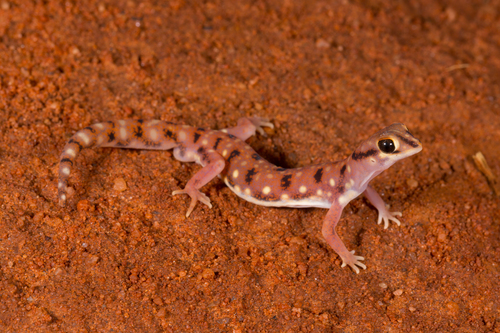
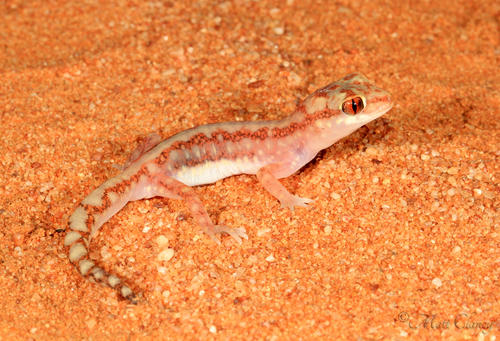
Lucasium damaeum, commonly known as the beaded gecko, is an endemic Australian species in the small genus Lucasium. This species reaches a total length of 7 cm. It is reddish brown on its dorsal surface, with distinct bead-like chains that surround a pale, cream-coloured ridged vertebral stripe – this pattern gives the species its common name, beaded gecko. Single lines of pale blotches run down the sides of its body, while scattered smaller spots cover its dark brown limbs and adjacent body regions. The beaded gecko has a rounded rather than beaked snout; the rostral scale connects to the nostril. The snout is reddish brown, and the upper eyelid is white or cream. This eyelid cannot cover, protect, or clean the eye; instead, the eye is covered by protective transparent scales, and the gecko uses its long, flat tongue to wipe its eye clean. It has relatively large eyes, with a thin vertical pupil during the day that becomes fully rounded in low light. The tail is a straight continuation of the body; an original tail carries the same body pattern down its length, but regenerated tails are plain brown or dark spotted. The toes are flat, unkinked, lack adhesive pads, and are usually whitish in colour. The structure of its feet means it is not suited for climbing. The beaded gecko is nocturnal: it hides during the day and travels large distances to forage for food at night. This species is found across the drier arid to semi-arid regions of mainland Australia, occurring in all mainland states and the Northern Territory. It is a terrestrial (ground-dwelling) gecko that occupies a variety of dry mainland Australian desert habitats, ranging from savannah woodlands to spinifex-covered sandhills. During the day, it shelters inside abandoned insect and spider holes, and emerges at night to hunt in open areas. This is a swift-moving species that covers large areas while searching for food. The beaded gecko is oviparous, meaning it reproduces by laying eggs rather than giving birth to live young. Females typically lay 2 eggs per clutch. Like most Australian reptiles, it has a defined breeding season that runs from late September through December. Males have paired, independently functioning sex organs.