About Lucanus cervus (Linnaeus, 1758)
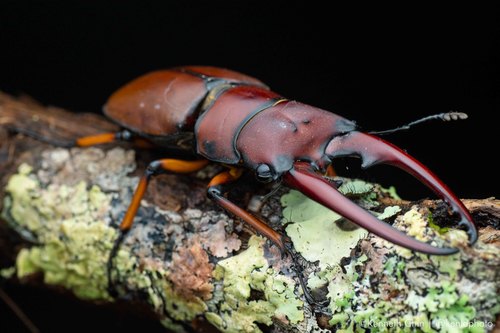
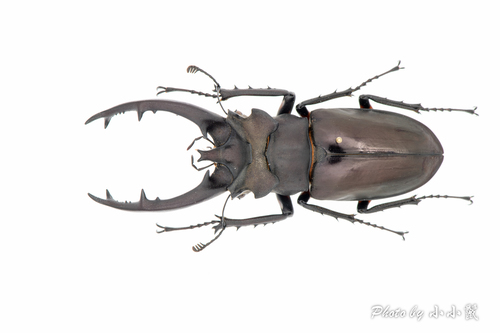
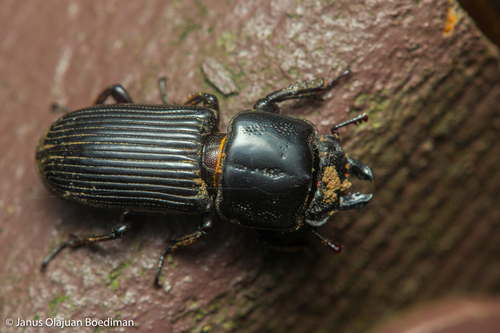
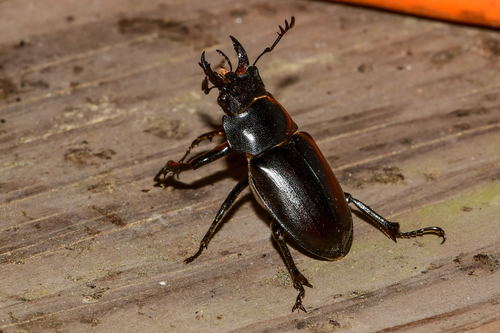
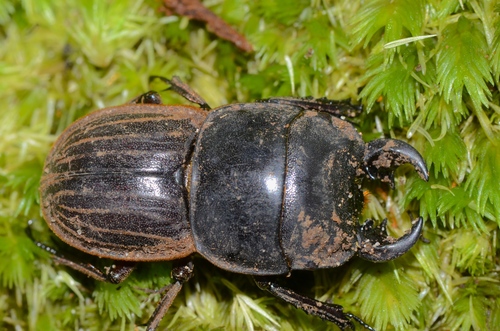
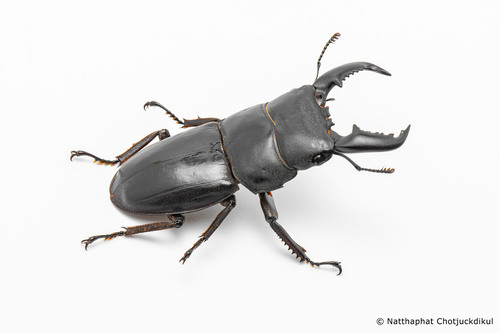
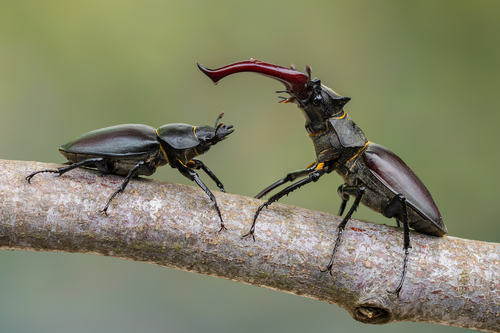
Lucanus cervus, commonly known as the European stag beetle, is the largest beetle species found in Europe. Most individuals are black with reddish elytra; males also have red mandibles. The species is strongly sexually dimorphic: males have greatly enlarged mandibles and are larger than females. While a male's large mandibles look threatening, they are too weak to cause harm. Females, by contrast, can deliver a painful bite. The similarity of male mandibles to a stag's antlers, plus the male habit of fighting one another just like deer, gives the species both its common name and scientific name. Adult body size varies across the species' distribution: beetles from Spain, Germany, and the Netherlands are larger than those from Belgium or the United Kingdom. Males can reach up to 7.5 centimetres (3.0 inches) in total length, while females grow between 3 and 5 centimetres (1.2 and 2.0 inches). In Britain, female Lucanus cervus are often mixed up with any sex of the lesser stag beetle, Dorcus parallelipipedus. The two can be told apart: lesser stag beetles are smaller, have an entirely black exoskeleton, and a larger, squarer head. A further key difference is that Lucanus cervus larvae feed on wood below ground, while Dorcus parallelipipedus larvae feed on wood above ground. Lucanus cervus is widespread across most of Europe, but it is not found in Ireland. In Germany it is widespread, and occurs most commonly in the south. In Hungary it is widespread across the country's hilly and mountainous areas. In Romania it is widespread, particularly in hilly areas with sun-exposed slopes. The species also occurs in the European portion of Turkey. In Italy, it is distributed mainly in northern and central regions. In both Spain and Portugal, it is only found in the northern half of each country. In Britain, it is mostly restricted to south-east England, where it is widespread. The species is now considered extinct in Latvia; it also disappeared from Denmark around 1970, but was successfully reintroduced to Denmark in 2013. Lucanus cervus is also found outside Europe, in the Caucasus, Asia Minor, Syria, and western Kazakhstan. As of the time this information was collected, the species' range is only increasing in Croatia and Slovakia. This beetle is associated with a wide range of tree types, including species from the genera Quercus (oak), Tilia (lime), Fagus (beech), and Salix (willow). It also associates with other tree species: black poplar (Populus nigra), common ash (Fraxinus excelsior), horse-chestnut (Aesculus hippocastanum), wild cherry (Prunus avium), and common walnut (Juglans regia). Larval development sites have been found near dead wood of the non-native red oak Quercus rubra. Adult European stag beetles emerge between late May and early August, and are most active during the evening. Females lay around 30 eggs in a piece of decaying wood buried deep in soil. Stag beetle larvae are blind and C-shaped, and feed on rotting wood in a variety of locations: tree stumps, old trees and shrubs, rotting fence posts, compost heaps, and leaf mould. Larvae have a cream-coloured, soft, transparent body, six orange legs, and a distinct orange head, with very sharp brown pincers. They have combs on their legs that they use for stridulation, acoustic communication with other larvae. Larvae go through multiple instar stages, and take several years to develop into pupae. Males use their large mandibles to fight one another while competing for mates, aiming to knock opponents off the log or branch they occupy. In work done in the late 1970s, entomologist Charlie Morgan found that stag beetle pupae develop in soil for around three months, then emerge in summer to fly awkwardly away to mate. Adult European stag beetles feed by sucking up liquid from nectar, fallen fruit, and tree sap. Their slow, heavy flight, which typically occurs at dusk, produces a distinctive low-pitched buzzing sound. Males fly more readily than females. When approached by a large object, the beetle's natural response is to stay completely still, which makes them easy subjects for photography. A study of radio-tracked Lucanus cervus in an ancient primary forest in northern Italy found that males were easier to locate than females. Males were more often recorded flying during tracking, while females mostly stayed underground near deadwood. Males were mostly observed flying at sunset, and resting or walking on standing trees during the day. A combination of air temperature and humidity sets the optimal weather conditions for male flight. Sunset flying, which is mostly done by males, significantly increases how easy the species is to detect. European stag beetles are more active during the first portion of their adult lives. Males are more likely to disperse than females, but there is no difference in the size of the home ranges between the two sexes. When the flight season is split into three intervals, the most active individuals were recorded during the first two intervals, which correspond to the first and second half of June.