About Lucanus capreolus (Linnaeus, 1763)
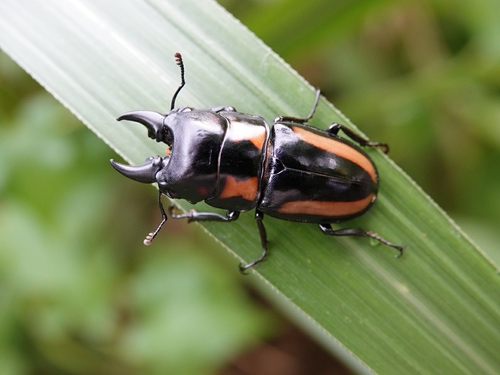
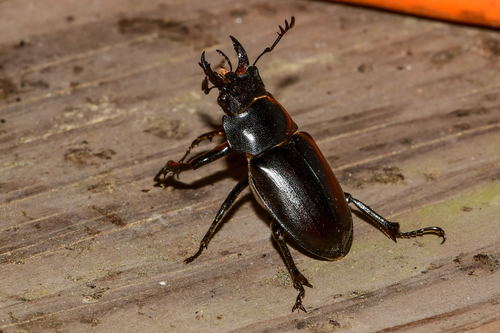
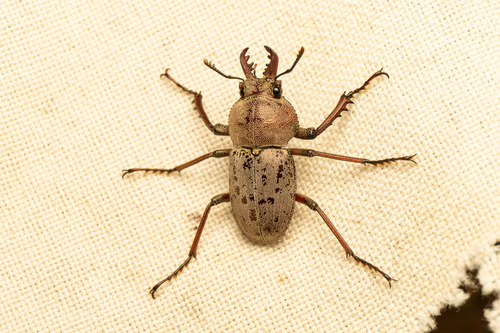
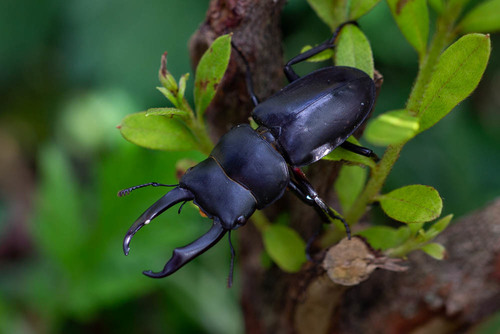
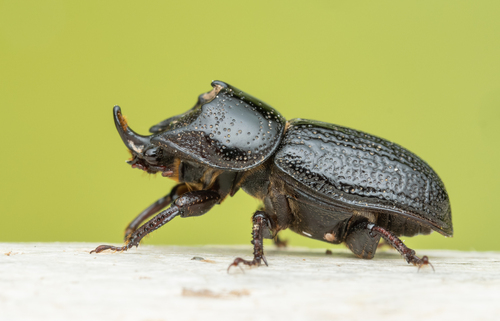
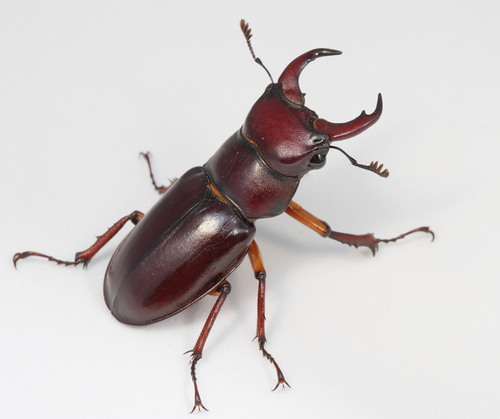
Lucanus capreolus is a relatively large stag beetle of the genus Lucanus. The species has a dark reddish brown body, smooth, shiny elytra (wing cases), and orange brown femora. Its body length ranges from 22 to 35 mm. Like most other species in the Lucanidae family, it has pronounced sexual dimorphism: males are larger than females, and have much larger mandibles (upper jaws) than females. Male Lucanus capreolus have long, curved upper jaws shaped like a sickle or antler. Male jaws of this species are not as large as those of Lucanus elaphus. The smaller species Lucanus placidus differs from Lucanus capreolus by having two or more teeth on its jaws and dark femora. Larvae of this species are found in the trunks of old trees, where they feed on inner wood. This species lives in deciduous forests and adjacent areas in the eastern United States and some parts of Canada. It breeds around decaying logs and stumps, and males use their mandibles to fight at these breeding sites. Females deposit eggs in rotting wood. Larvae develop in the decaying wood of deciduous trees, and reportedly take two years to fully develop. Once developed, larvae pupate in nearby soil. Adult Lucanus capreolus are attracted to lights at night. Captive individuals have been observed to make burrows and nest in soil and mulch. This species was originally described by Carl Linnaeus in 1763 as Scarabaeus capreolus in his Centuria Insectorum, which is the original combination for its current scientific name Lucanus capreolus (Linnaeus, 1763). The known scientific synonyms of this species are L. dama Fabricius 1775: 2, L. trigonus Thunberg, 1806: 199, and L. muticus Thunberg, 1806: 205.