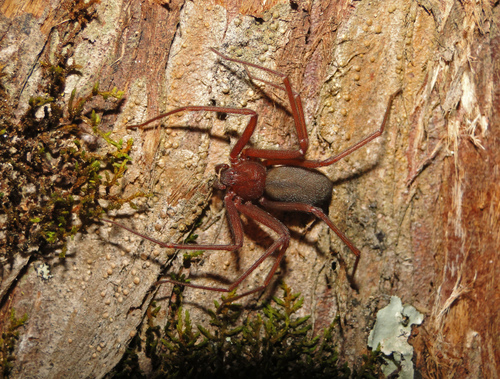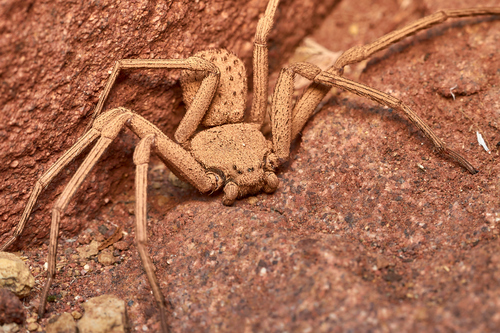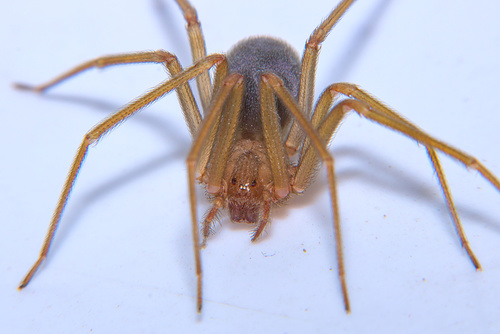
About Loxosceles rufescens (Dufour, 1820)
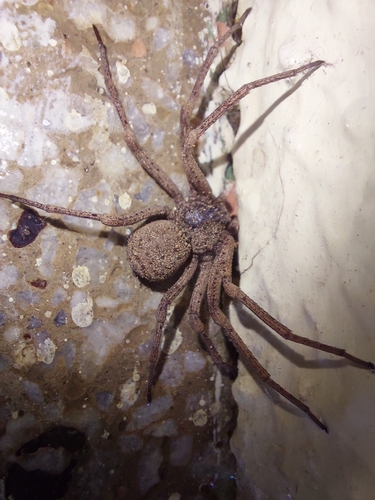
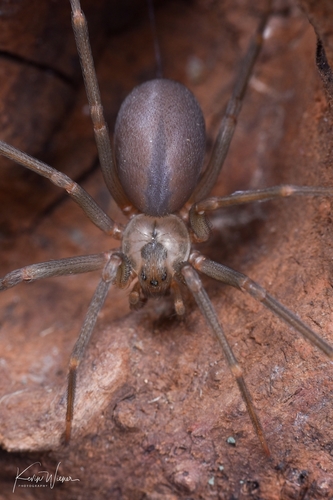
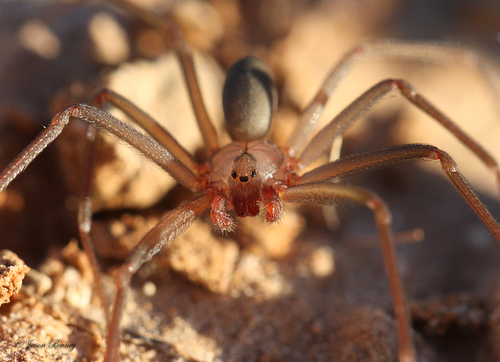
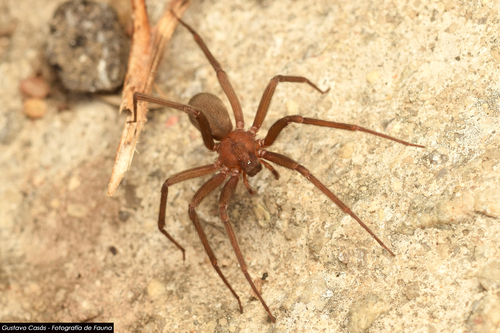
Loxosceles rufescens, also known as the Mediterranean recluse spider, is a cave-dwelling arachnid nearly identical in appearance to Loxosceles reclusa, the brown recluse spider. It is a medium-sized spider that can be identified by its unique eye arrangement: three pairs of eyes, for a total of six eyes, arranged in a triangle, while most spiders have eight eyes. It also has a characteristic violin-shaped pattern on its cephalothorax. Both males and females reach approximately 7–7.5 mm in body length. This species belongs to the genus Loxosceles, a group that includes many of the world’s most dangerous spiders. The egg sacs of Loxosceles rufescens hold approximately 40 eggs each; hatching takes a few weeks, depending on environmental temperature. Young spiders grow slowly and molt repeatedly as they grow, and their shed molts often have a pale, ghostly appearance. Adult Mediterranean recluse spiders typically live between one and three years. The webs spun by Mediterranean recluse spiders serve as daytime hiding spots and protected locations for their egg sacs. These webs are very thin and fragile, made of disorganized, irregular silk strands. The Mediterranean recluse is classified as one of the world’s most invasive species. It is native to the Mediterranean region and western Asia, including parts of Europe and Northern Africa, and prefers warm, generally dry conditions. Due to increased human travel and global trade of transported goods, the species now has a worldwide distribution. It has been introduced to Madagascar, southeast Asia ranging from India to Japan, Australia, numerous Atlantic and Pacific islands (including four islands in the Hawaiian archipelago). In North America, it has been recorded in more than 20 U.S. states, scattered widely from California to Florida and as far north as Michigan, as well as in Ontario, Canada. In South Africa, only one single specimen has ever been recorded, collected from Cape Town in 1914. In non-native regions, L. rufescens can be found in semi-arid environments and damp spaces such as basements, caves, and tunnels. In these habitats, the spiders commonly feed on cockroaches and silverfish. In 2021, during a routine building pest inspection, this species was found in the basement of the University of Michigan’s Shapiro Undergraduate Library, which resulted in the library closing for two days. Loxosceles rufescens has predatory behavior that differs from many other spider species. It is an active hunter that travels at night to find and kill a range of arthropods susceptible to its venom, rather than catching prey in a web. It is most active after dark, and typically targets smaller insects because of their soft, vulnerable exoskeletons. Males hunt more actively than females, in part because they travel to search for potential mates.