About Loxosceles reclusa Gertsch & Mulaik, 1940
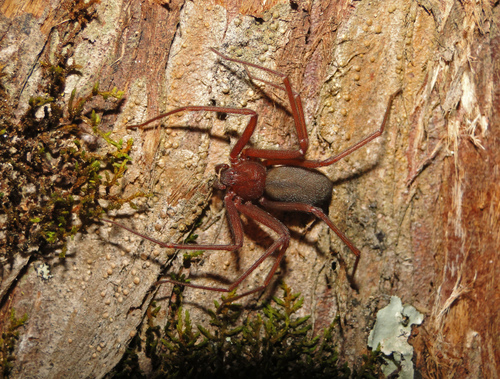
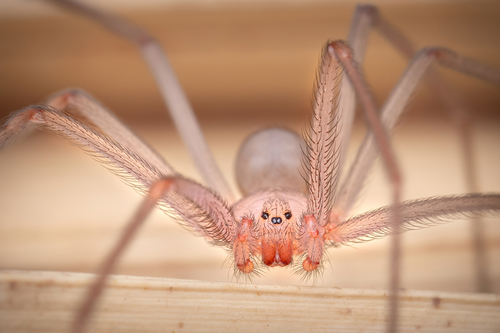
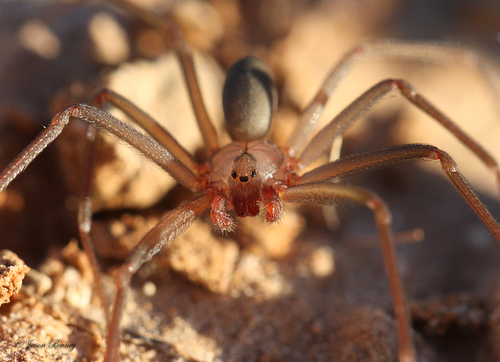
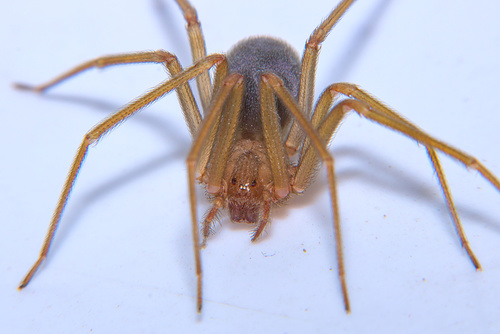
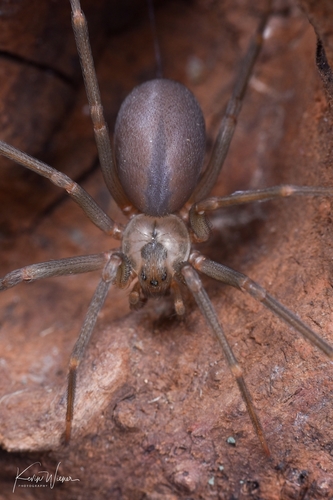
The brown recluse spider, Loxosceles reclusa Gertsch & Mulaik, 1940, cannot be definitively identified by its characteristic violin pattern, because other spider species including cellar spiders and pirate spiders can have similar markings. Unlike most spiders, which have eight eyes, brown recluse spiders have six eyes arranged in three pairs: one median pair and two lateral pairs. Only a small number of other spider groups, such as scytodids, share this eye arrangement. Brown recluses have no obvious distinct color patterns on their abdomens or legs, and their legs have no spines. The intensity of the violin marking on a brown recluse can vary with the spider's age; mature spiders typically have darker, clearer violin shapes.
The documented native range of Loxosceles reclusa lies roughly south of a line running from southeastern Nebraska through southern Iowa, Illinois, and Indiana to southwestern Ohio. In the southern United States, the species is native from central Texas to western Georgia, and north as far as Kentucky. Contrary to common rumors, brown recluses have not established permanent populations in California or anywhere outside of this native range. Other Loxosceles species are native to the southwestern United States, including California, and these species can look very similar to the brown recluse. Interactions between humans and these native southwestern recluse species are rare, because their natural ranges fall outside of dense human population areas.
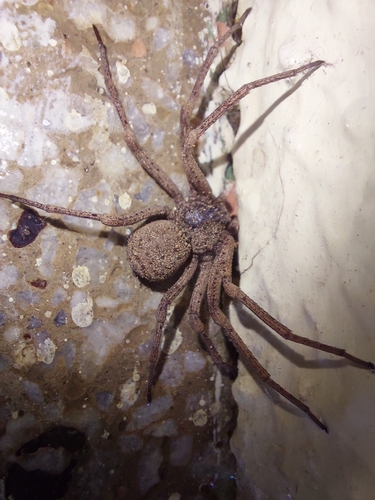
There is a very high number of false positive reports of brown recluses caused by misidentification. In one nationwide study that collected spiders people believed were brown recluses, only 1 out of 581 specimens from California was actually a brown recluse; this single specimen was brought into the state by a family that moved from Missouri. By comparison, 75% to 90% of specimens submitted from Missouri, Kansas, and Oklahoma were correctly identified as brown recluses. The most common spider misidentified as a brown recluse in California belongs to the genus Titiotus, whose bites are considered harmless. A separate similar study found that physicians, pest control operators, and other non-expert authorities regularly misidentify various arachnids as brown recluses when they are not. Even though brown recluses do not live in the western United States, physicians in the region very commonly diagnose "brown recluse bites", which has reinforced the popular misconception that the species lives there.
Over the past century, individual brown recluses have occasionally been found in locations where the species has no known established populations. The spiders can be easily transported long distances by human activity, but the lack of established brown recluse populations far outside the natural range shows that this accidental movement has not led to successful colonization of new areas, even after decades of opportunities. A single brown recluse population restricted to one building, such as a warehouse, outside the native range is not counted as successful colonization; such isolated single-building populations have been recorded, for example in multiple cases in Florida, but they do not spread to surrounding areas and can be easily eradicated. There have also been many sensationalized media reports of brown recluse bites in regions where the spider does not exist, and no specimens were ever found in these areas; one example is a 2014 report from Thailand that claimed a man died from a brown recluse bite.
Many misidentifications and incorrect geographic records of brown recluses come from the similarity between L. reclusa and the closely related introduced Mediterranean recluse, Loxosceles rufescens. The Mediterranean recluse is found across the world, including many sightings throughout the United States. The two species are almost identical on the surface, so misidentifications are very common, making it hard to tell which species older recluse reports actually refer to.
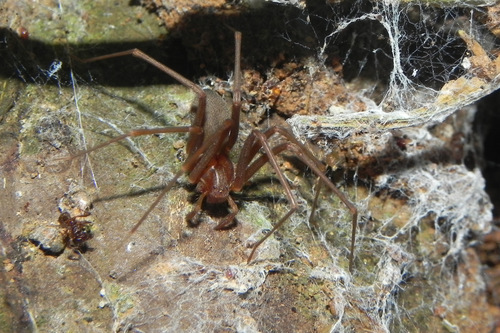
Brown recluse spiders build irregular asymmetrical webs, which usually include a shelter made of loosely tangled disordered threads. They most often build their webs in dry, generally undisturbed places: common sites include woodpiles, sheds, closets, garages, plenum spaces, and cellars. When they live in human homes, they tend to prefer cardboard, possibly because it has a similar texture to the rotting tree bark that they naturally inhabit in the wild. Contact between humans and brown recluses usually happens when these isolated undisturbed spaces are disturbed, and the spider feels threatened. Unlike most web-building spiders, brown recluses leave their shelters at night to hunt prey. Males travel over larger areas while hunting, while females tend to stay closer to their webs.
Adult brown recluse spiders typically live one to two years. Each female produces multiple egg sacs over a two to three month period from May to July, with roughly 50 eggs in each sac. Eggs hatch after about one month. Spiderlings take approximately one year to reach full adulthood. Brown recluses are very resilient spiders: they can tolerate up to six months of extreme drought and little to no food. In one recorded case, a captive brown recluse survived for over five seasons without eating any food at all. As members of the haplogynae group, brown recluses do not balloon (disperse via wind carried silk), which limits their ability to spread to new geographic areas. Brown recluses will occasionally cannibalize other brown recluses when food is scarce, though this is not a regular behavior. Cannibalism is especially common during the typical mating season from June to September, or when an unreceptive female encounters an aggressive male.