About Loxorhynchus grandis Stimpson, 1857
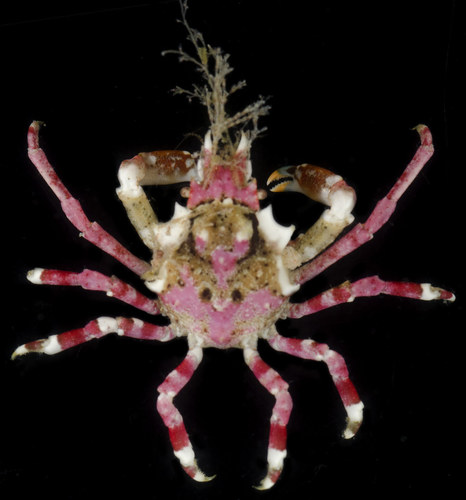
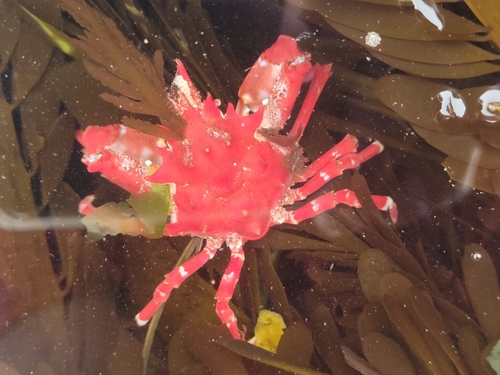
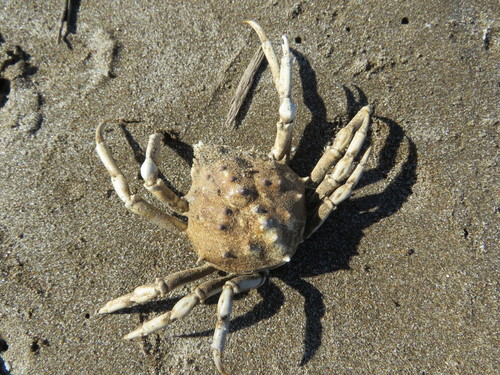
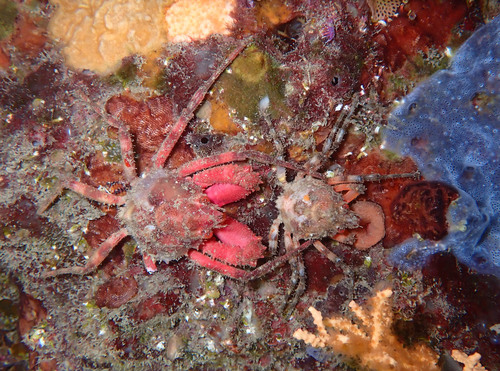
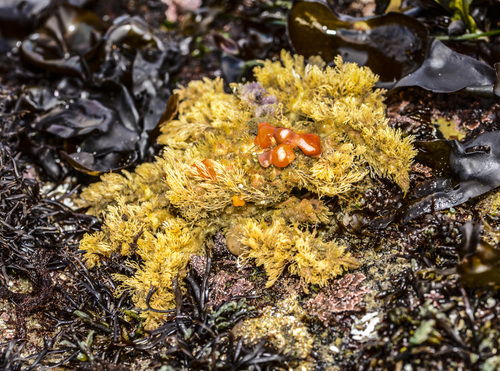
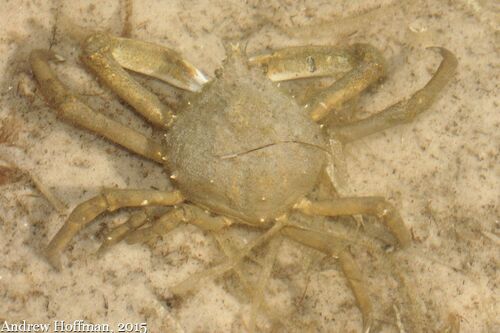
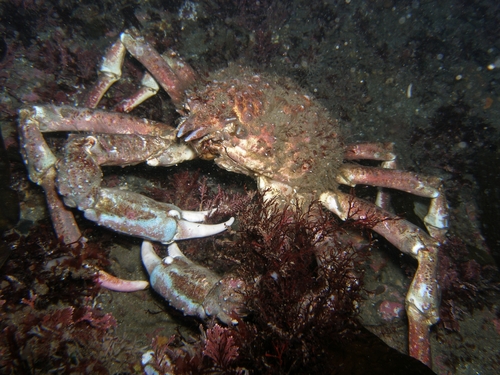
This species, commonly known as the sheep crab, has a scientific name of Loxorhynchus grandis Stimpson, 1857. The sheep crab has one carapace, four pairs of walking legs, and one pair of claws called chelipeds. Males grow larger than females: a male's carapace can measure over 9.6 inches (24 cm) across, while a female's carapace can reach up to 6.8 inches (17 cm) across. The carapace is tear-shaped, with a wide, rounded posterior that tapers to a point at the snout, also called the rostrum. There is a distinct preorbital spine at the tip of the rostrum; this spine is sharply down-curved and deeply notched at its end. The carapace is covered in short spines, also called tubercles. The longest legs, the second pair of walking legs, are longer than the carapace is wide, so sheep crabs can reach a total overall width of 57 centimetres (22 in). The exoskeleton, or shell, is naturally reddish, brown, or blue-green, but this natural color is often hidden. Young sheep crabs intentionally attach algae, bryozoans, hydroids, sponges, and other organisms to their exoskeletons as camouflage to avoid predators. Once individuals grow larger than 8 centimetres (3.1 in), they stop decorating their shells this way. This species stops molting once it reaches sexual maturity, and a layer of algae often grows on the long-lived adult exoskeleton, giving adult crabs a green appearance. Sheep crabs inhabit coastal waters ranging from Cordell Bank, California to Punta San Bartolome, Baja California. They live in waters between 6 metres (20 ft) and 152 metres (499 ft) deep. Sheep crabs are highly mobile, reaching movement speeds of 0.4 kilometres per hour (0.25 mph), and forage on soft and rocky seabeds, as well as on pilings. This is a migratory species: it spends the warm months of the year in shallow water, and moves to deeper water during the cooler months. Sheep crabs are gonochoric, meaning every individual is either male or female. They occasionally form aggregations, which are piles containing dozens or hundreds of crabs. Studied aggregations are made up only of adult crabs, and include females plus at least one male. Sheep crabs are typically solitary, so researchers have hypothesized that aggregations form to increase the concentration of a female pheromone chemical signal, to attract males for mating. A male grasps a female for mating and delivers a sperm packet. Females can store sperm for later use if no males are immediately available. Fertilization occurs internally, and fertilized eggs are then glued to the outside of the female's abdomen. Females brood their eggs to protect them from predation. Egg broods can contain between 125,000 and 500,000 eggs. Egg development stage can be identified by egg color: orange eggs are newly laid, red eggs are at an intermediate development stage, and brown eggs have visible eyes and are ready to hatch. Brooding females have been found year-round, which suggests there is no strong seasonal peak for sheep crab reproduction. The length of the brooding period is currently unknown. After hatching and being released by the female, larval sheep crabs are free-swimming plankton. They settle to the seabed and become recognizable as sheep crabs when they grow to about 1 centimetre (0.39 in) across. Like other crabs, sheep crabs must molt to grow, because their rigid, thick exoskeleton cannot expand as the soft animal inside it grows. To molt, sheep crabs first form a soft new shell inside their existing exoskeleton. They then create a slit at the back of the carapace and back out of the old shell. The new soft shell is then actively inflated with water, and hardens at this inflated size. The animal gains room for future growth by displacing the water inside the new hard shell. This molting process also allows sheep crabs to regenerate limbs lost since their last molt. Unlike most crab species, sheep crabs stop molting once they reach sexual maturity. This terminal molt ends their ability to grow and regenerate lost limbs. The maximum lifespan of this species is unknown, but it is at least three years.