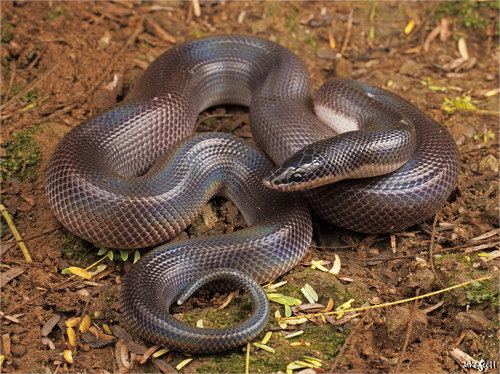
About Loxocemus bicolor Cope, 1861
Description: Adult Loxocemus bicolor reach a maximum total length of 1.57 m (62 in), with an average length of roughly 91 cm (2.99 ft). Their bodies are stout and very muscular. To suit their burrowing lifestyle, they have a shovel-shaped snout, narrow head, and small eyes. Both male and female individuals have various scent glands across their bodies that secrete fatty acids and alcohols to deter nuisance arthropods, including ants and other burrowing insects. This species is terrestrial and semi-fossorial, a trait that makes it difficult to observe and study in the wild. Its typical color pattern is dark with patches of white scales; occasionally, after shedding, all pigment can disappear, producing a completely white snake with only a small dark patch remaining on the head. Scale color can also range between pinkish-brown and reddish-brown, which provides camouflage matched to the soil type of the region an individual inhabits. Distribution and habitat: This species is found along the Mexican Pacific versant at low to moderate elevations in the Mexican states of Nayarit, Jalisco, Colima, Michoacán, Morelos, Guerrero, Oaxaca, and Chiapas. Its range extends south from Mexico through Guatemala, Honduras, El Salvador, Nicaragua, and Costa Rica. The designated type locality for the species is "La Unión, San Salvador" in El Salvador. Life cycle and ecology: Loxocemus bicolor occurs in a wide variety of habitats, including tropical, moist, and dry forests. In Honduras and Guatemala, it can also be found in dry inland valleys that drain into the Caribbean. Its diet is thought to be made up of rodents and lizards; it also preys on arthropods such as underground insects and centipedes, as well as worms. Individuals have been observed eating iguana eggs, and will also consume sea turtle eggs and hatchlings when food is scarce. This species is oviparous, laying small clutches of two to four eggs per breeding event. To consume eggs, individual snakes have been observed wrapping two to three loops of their anterior trunk around the egg to apply pressure and pierce it, before swallowing the yolk whole.

