About Loxia leucoptera J.F.Gmelin, 1789
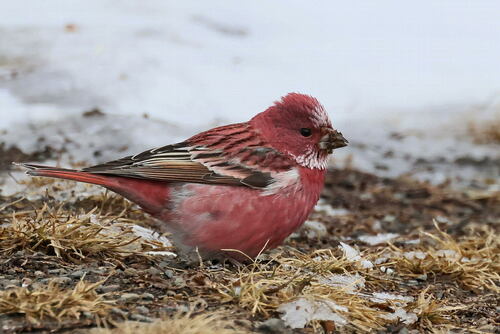
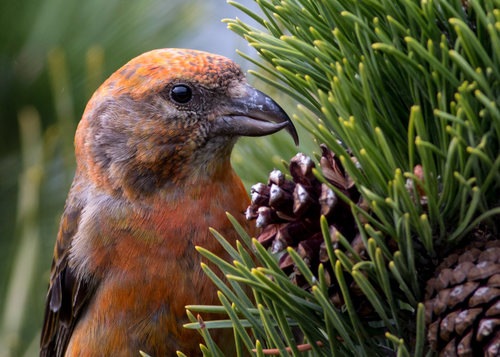
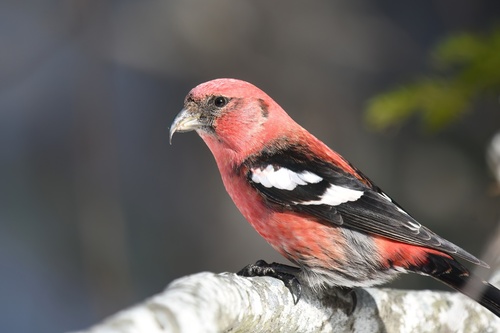
The two-barred crossbill (scientific name Loxia leucoptera J.F.Gmelin, 1789) measures 14.5–17 cm (5.7–6.7 in) in length and weighs 25–40 g (0.88–1.41 oz). It has short legs, a forked tail, a crossed bill, and two prominent white wing-bars. For males of the nominate subspecies, the forehead, crown, nape, and upper parts are bright raspberry-red; the scapulars are black or blackish brown with pink edges, and the upper tail coverts are black with white fringes. Females have no pink coloration, and instead have greenish-yellow heads and upperparts. The two-barred crossbill is easier to identify than other crossbill species, especially in North America, where only the red crossbill (Loxia curvirostra) and this species are found. Within its Palearctic range, this species has a smaller head and smaller bill than the parrot crossbill and Scottish crossbill, so the main identification confusion both here and in North America is between the two-barred crossbill and the red or common crossbill. The main plumage difference that separates the two-barred crossbill from the red crossbill is the white wingbars, which give this species its English and scientific names. The two-barred crossbill also has white tips on its tertials. Adult males are also a somewhat brighter, pinker red than males of other crossbill species. Some red crossbills occasionally have weak white wingbars, so careful observation is needed for correct identification of the two-barred crossbill. Its chip call is weaker and higher in pitch than the call of the red crossbill. A crossbill species found on Hispaniola in the Caribbean was previously classified as a subspecies of the two-barred crossbill (Loxia leucoptera megaplaga), but is now recognized as a separate full species: the Hispaniolan crossbill (Loxia megaplaga). This species is associated with the Hispaniolan pine tree (Pinus occidentalis), and differs from the two-barred crossbill in having darker plumage, a stouter bill, and geographic isolation from other crossbill species. The two-barred crossbill breeds in coniferous forests across Alaska, Canada, the northernmost United States, and across the Palearctic extending into northeast Europe. It builds its nests in conifers and lays 3–5 eggs per clutch. This crossbill is mainly a resident species, but will undergo irregular irruptions further south when its food source fails. The American subspecies appears to wander more frequently than the Eurosiberian subspecies. Outside of the breeding season, this species forms flocks, often mixed with other crossbills. It is a rare visitor to western Europe, usually arriving alongside irruptions of red crossbills. Two-barred crossbills are specialist feeders on conifer cones, and their unusual crossed bill shape is an adaptation that helps them extract seeds from cones. The two-barred crossbill has a strong preference for larch (Larix): in Eurosiberia it uses Siberian larch (Larix sibirica) and Dahurian larch (L. gmelinii), and in North America it uses Tamarack larch (L. laricina). It will also eat rowan (Sorbus) berries, and in North America it also feeds on cones from eastern hemlock (Tsuga canadensis) and white spruce (Picea glauca).