About Loxia curvirostra Linnaeus, 1758
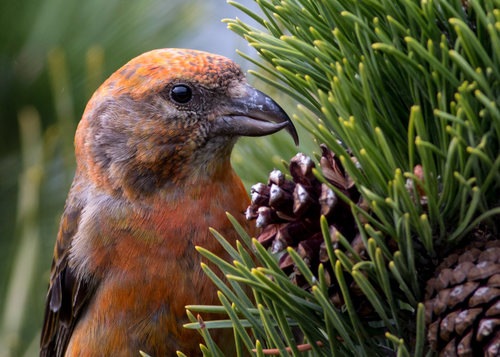
This species, Loxia curvirostra Linnaeus, 1758, is commonly called the red crossbill. Crossbills as a group get their English name from the distinctive feature of their mandibles crossing at the tips. Using this crossed structure for leverage, crossbills can efficiently separate the scales of conifer cones to extract the seeds they feed on. For red crossbills, adult males are typically red or orange, while females are typically green or yellow, though there is a great deal of plumage variation. The species' distinctive crossed mandibles rule out identification as most other bird species. However, this crossed mandible feature is shared with the similar two-barred crossbill, and the two species have considerable overlapping range. Two-barred crossbills have two bright white wing bars, while red crossbills have entirely brownish-black wings. Across most of its range, the red crossbill is the only crossbill species with dark wings. It does overlap, at least seasonally, with the small ranges of three other very similar crossbill species: parrot crossbill, Scottish crossbill, and Cassia crossbill. These three species were formerly classified as subspecies of the red crossbill. They differ only very slightly from the red crossbill in bill size and shape, making them very hard to tell apart visually, and they are generally best distinguished by their calls. There are negligible plumage differences between these four crossbill species; more variation in plumage occurs between individual birds than between the species. Standard measurements for the red crossbill are: length 20 cm, weight 40–53 g, and wingspan 27–29 cm.