About Lotus glaucus Aiton
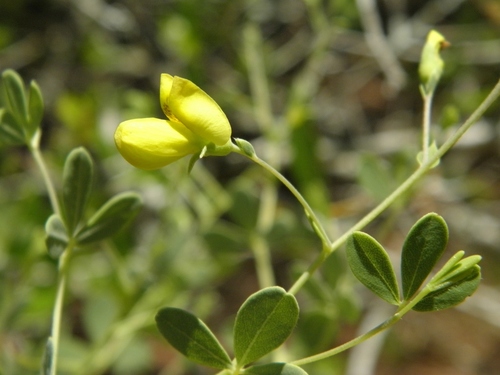
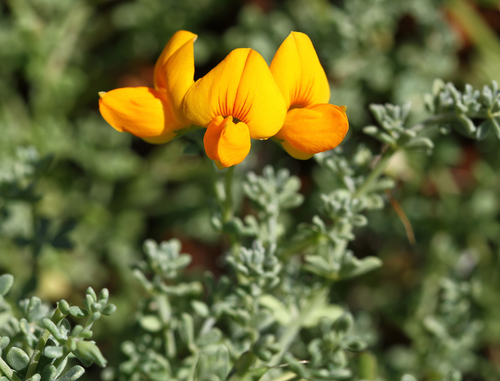
Lotus glaucus Aiton is a perennial herbaceous species that typically forms dense mats, though it can sometimes be somewhat shrubby. Its leaves are stalkless (sessile) and bear five pinnate leaflets. For the nominate subspecies, Lotus glaucus subsp. glaucus, the two basal leaflets measure 1.5–4.5 mm long. A short central axis, called a rhachis, up to 2 mm long, separates these basal leaflets from the remaining three leaflets, which are 2–8 mm long—longer than the basal leaflets. Leaflets of the second subspecies, L. glaucus subsp. salvagensis, are generally longer, growing up to 13 mm. Stems and leaves are covered in straight hairs that lie flat against the surface. Hair density varies across plants: those with dense hairs appear silvery, while those with sparser hairs appear greener. Flowers are arranged in umbels, most commonly holding 1 to 3 flowers per umbel, and occasionally up to five. Petals are initially orange to reddish, or sometimes deep yellow, and turn reddish-brown after fertilization. The upper petal, called the standard, is shorter than or equal in length to the 10–15 mm long keel petals. Wing petals measure 9–14 mm long, and are usually shorter than the keel. The fruit pods are straight. In terms of distribution and habitat, strictly defined L. glaucus (sensu stricto) is native to Madeira, home to subsp. glaucus, and the Salvage (or Savage) Islands, home to subsp. salvagensis. It may also occur on Fuerteventura in the Canary Islands, if collected specimens from the island belong to this species. If Lotus tenellus is treated as part of L. glaucus, the species’ distribution extends to the coastal zones of Tenerife and Gran Canaria.