About Lottia gigantea G.B.Sowerby I, 1834
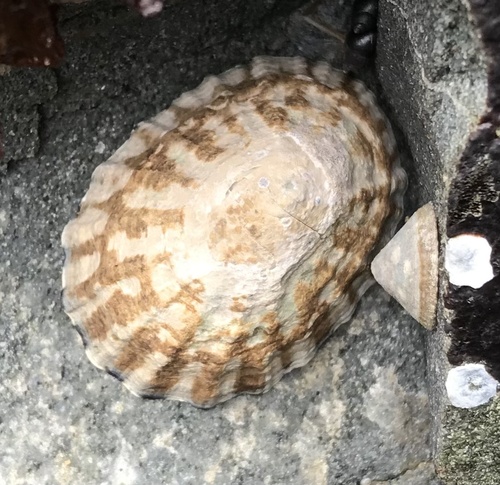
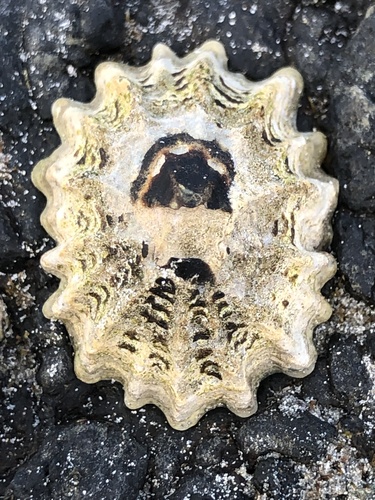
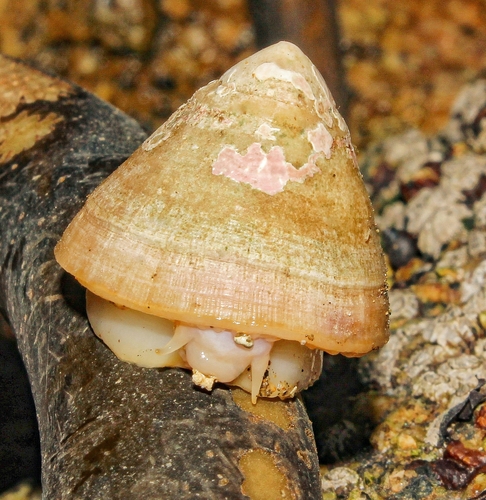
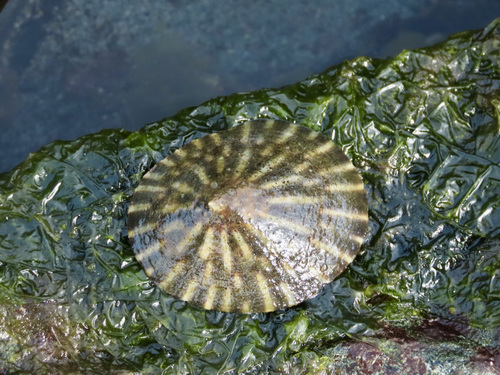
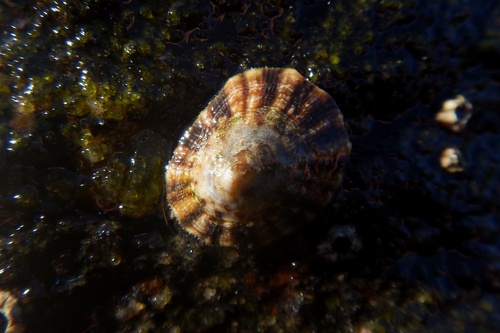
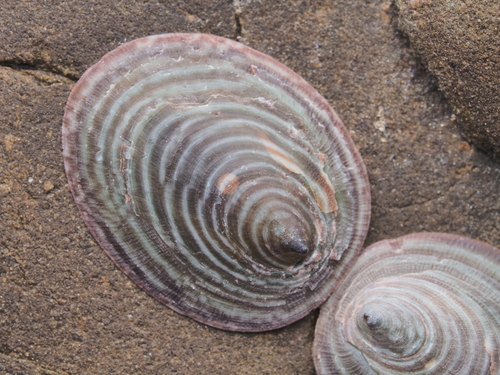
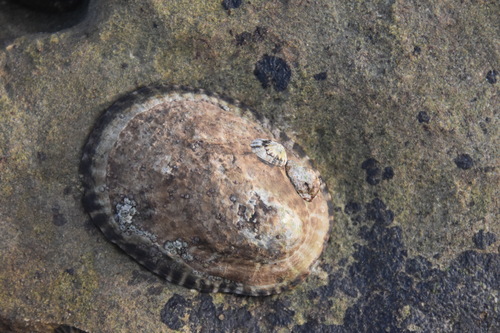
Lottia gigantea, commonly known as the owl limpet, reaches a maximum length of nine centimeters. Its shell is often heavily eroded, shaped like an elongated low cone with its apex positioned close to one end, and has a concave anterior slope. The shell's general color is brownish grey with pale markings; the foot is pale grey with a yellow or orange sole. A smaller morph of this species lives on mussel shells: this form is more elongated, grows up to twenty-five millimeters long, is dark blue, and displays concentric growth rings. All Lottia gigantea have a muscular orange foot. Around the edge of the foot, the owl limpet has a distinctive pallial gill system; when the limpet is submerged, cilia beating creates currents that circulate water over the gills. The owl limpet occurs along the Pacific coast of North America, ranging from northern California to southern Baja California. It is most abundant in California, and favors vertical rock faces in wave-swept areas of the upper littoral zone. This species grows slowly and may live up to twenty years. It feeds by browsing on microalgae that grow on rock surfaces. The owl limpet is a territorial species, and some individuals return to the same specific homesite every time the tide goes out. Over time, the limpet's contours grow to tightly fit the shape of its homesite rock surface. Owl limpets are protandric hermaphrodites. Individuals spend approximately two years as juveniles before beginning their reproductive lives as males. If they survive long enough, some later transform into females. Spawning occurs once annually in winter. The larvae are pelagic and form part of the zooplankton, and may be carried large distances by currents before settling on suitable rock surfaces. Larger individuals often have encrusting organisms such as barnacles and algae growing on their shells. Sometimes other limpets or chitons graze on the microalgae that grows on these occupied owl limpet shells. The black oystercatcher, Haematopus bachmani, is the only known natural predator of the owl limpet, and the species is also harvested by humans for food.