About Lota lota (Linnaeus, 1758)
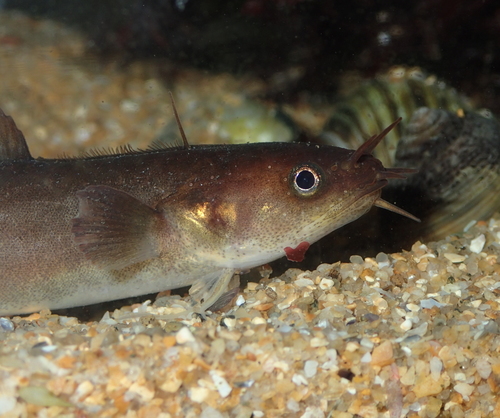
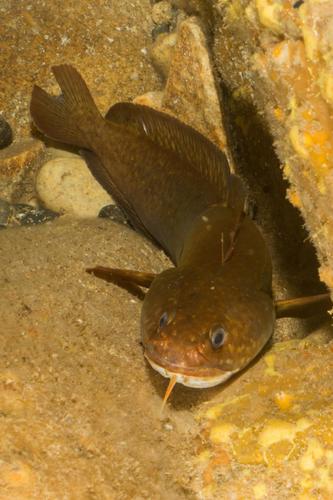
The burbot, scientifically named Lota lota (Linnaeus, 1758), has an appearance that looks like a cross between a catfish and an eel. It has a serpent-like elongated body that is laterally compressed, paired with a flattened head and a single tube-like projection for each nostril. It is easily distinguished by a single barbel on its chin. It has a wide mouth, and both its upper and lower jaws hold many small teeth. Burbot have two soft dorsal fins: the first is low and short, while the second is much longer. The anal fin is low and nearly as long as the second dorsal fin. The caudal fin is rounded, the pectoral fins are fan-shaped, and the pelvic fins are narrow with an elongated second fin ray. Its small fins, which are small relative to its body size, indicate it has a benthic lifestyle with low swimming endurance, and cannot withstand strong currents. Although it appears scaleless, the burbot actually has minute, almost microscopic scales. Burbot are relatively long-lived and slow-growing. In Alaska, it generally takes 5 to 7 years for a burbot to reach 18 inches in length, individuals typically reach sexual maturity at 6 to 7 years of age, and it is not uncommon to find individuals over 20 years old. Burbot have a circumpolar distribution above 40° N. Their populations form a continuous range from France across Europe, and mainly through Russian Asia, to the Bering Strait. In North America, burbot range from the Seward Peninsula in Alaska to New Brunswick along the Atlantic Coast. They are most common in the streams and lakes of North America and Europe. They are fairly common in Lake Erie, and are also found in the other Great Lakes. There is also an anadromous population that lives in the brackish waters of the Baltic Sea. Recent genetic analysis suggests that the geographic pattern of burbot may indicate the existence of multiple species or subspecies, which means treating burbot as a single taxon is somewhat misleading. Burbot live in large, cold rivers, lakes, and reservoirs. They primarily prefer freshwater habitats, but can also thrive in brackish environments for spawning. For part of the year, burbot live under ice, and they require frigid temperatures to breed. During the summer, they are typically found in the colder water below the thermocline. In Lake Superior, burbot can live at depths below 300 m (980 ft). As benthic fish, they tolerate a wide range of substrate types including mud, sand, rubble, boulder, silt, and gravel for feeding. Adult burbot dig extensive burrows in the substrate to use for shelter during the day. Burbot are active crepuscular hunters. Burbot populations are adfluvial during the winter, and they migrate to near-shore reefs and shoals to spawn, preferring spawning grounds made of sand or gravel.