About Loris lydekkerianus Cabrera, 1908
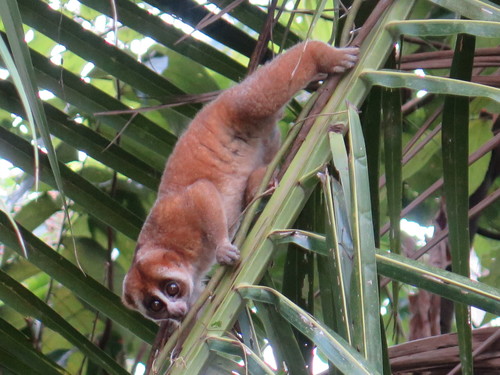
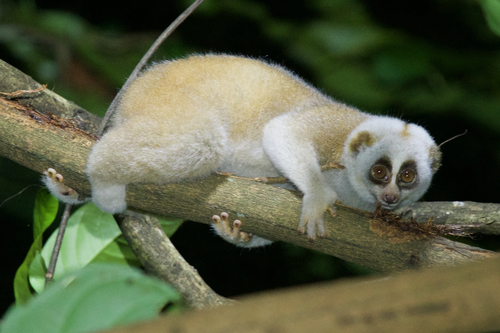
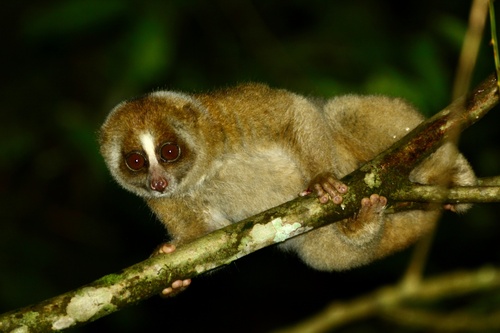
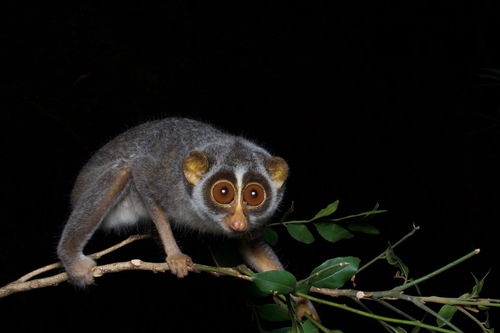
Loris lydekkerianus Cabrera, 1908 (gray slender loris) is a slender loris, with all members of this group having extremely gracile limbs and extreme stereoscopic vision. Gray slender lorises show wide variation in pelage (fur) color, and each subspecies can be identified by this variation. Their fur is short and gray or reddish on the back; sometimes a darker stripe extends from the top of the head to the end of the back. The ventrum (underbelly) is white or buff-colored. The eyes are surrounded by darker fur, their orbits face straight forward to produce excellent stereoscopic vision, and the eyes are positioned closer together than in any other primate. Between the eyes there is a white patch of hair called the median stripe. The muzzle is larger and less pointed than that of the red slender loris. The hands are highly specialized with a reduced second digit that allows the loris to cling to small branches. This ability is further enhanced by adaptations in the first metatarsal that are thought to enable an extremely firm grasp. The tail is vestigial. Average head-body length is 18–26 centimetres (7.1–10.2 in). For Sri Lankan subspecies, Loris lydekkerianus grandis has short ears and a heart-shaped face. The basal ventrum hairs of Loris lydekkerianus grandis are black, while those of Loris lydekkerianus nordicus are white. Gray slender lorises are found in southern India and Sri Lanka. They inhabit primary and secondary rainforest, dry semi-deciduous forest, and montane cloud forest up to 2,000 metres (6,600 ft) above sea level. In south-western India, their range lies roughly between the Tapti and Godavari Rivers, extending down to the south coast of the subcontinent. The subspecies are geographically separated. In south-western India, the Malabar gray slender loris occurs in the wet forests of the Western Ghats in the states of Karnataka, Kerala and Tamil Nadu up to an altitude of 1,200 metres (3,900 ft). The Mysore gray slender loris inhabits the tropical dry forests of the Eastern Ghats in the states of Andhra Pradesh, Karnataka and Tamil Nadu, and is common in open Euphorbia scrub forests and on Acacia trees at an altitude of 300–500 metres (980–1,640 ft). It can also be found on the dry eastern slopes of the Western Ghats. Gray slender lorises are promiscuous: multiple males compete for one female for mating. Mating occurs biannually, in April–June and October–December. Although mating occurs twice a year, lorises can only breed once a year, as one estrus cycle will fail and another will begin approximately 2 weeks after the failed cycle. Gestation is approximately 170 days. Twins are very common among this species. The reproductive tract and ovarian cycle follow the general mammalian pattern. For lactation, four teats develop and produce milk before the infant is born. After giving birth, females are not receptive to males and focus on caring for their young. The reproductive rate of the gray slender loris is among the lowest of any primate weighing under 500g.