About Loriculus philippensis (Statius Muller, 1776)
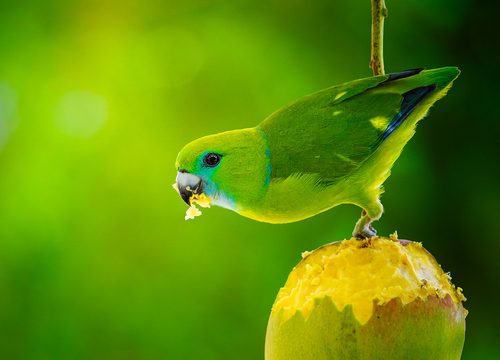
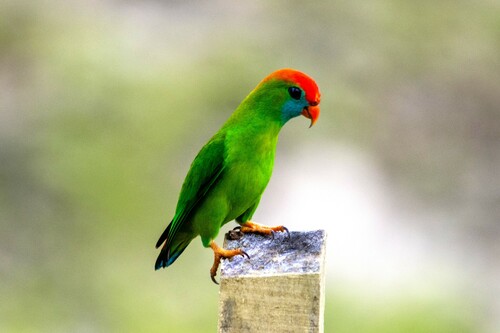
Philippine hanging parrots measure around 14 cm (5.5 in) in length, weigh 32–40 grams, and have short rounded tails. Their plumage is primarily green, with variable patches of red, orange, yellow, and blue that differ between subspecies. They have red foreheads and dark brown irises. Adult individuals have red beaks and orange legs. This species is sexually dimorphic: only males have red markings on the chin or upper chest, with the exception of the subspecies Loriculus (philippensis) camiguinensis, where neither males nor females have a red bib or chest patch. Juveniles have less red coloration on the head and paler beaks, but otherwise resemble adult females.
The Philippine hanging parrot is native to the Philippines, with the exception of the Sulu Archipelago, and it is not widespread on Palawan. Each of its different subspecies is native to separate islands, and some of these subspecies are rare or nearly extinct. Trade of these birds between islands for the pet trade has led to escaped pet birds living on islands outside of their original native range. Its natural habitats include tropical moist lowland forests, bamboo forests, and tropical moist montane forests. It also lives in human-modified habitats such as coconut groves and secondary forest. It is most common in lowland areas, and is rare at elevations above 1250 m.
Philippine hanging parrots are most often seen alone or in pairs, and only rarely form small groups. They usually forage for food in the forest canopy or middle storeys. Their diet consists of nectar, flowers, and soft fruits, including figs from Ficus trees. This species breeds seasonally, with nesting taking place from March to May. Like most parrots, it nests in cavities; one wild nest was recorded in a cavity high in a dead tree. It is one of the few parrot species that uses nesting material, with females tucking nesting material between their feathers to carry it back to the nest. In captive conditions, clutch size is 3 eggs, which are incubated for 20 days. Chicks fledge around 35 days after hatching. Their rounded eggs measure approximately 18.7 x 16.4mm.