About Loriculus galgulus (Linnaeus, 1758)
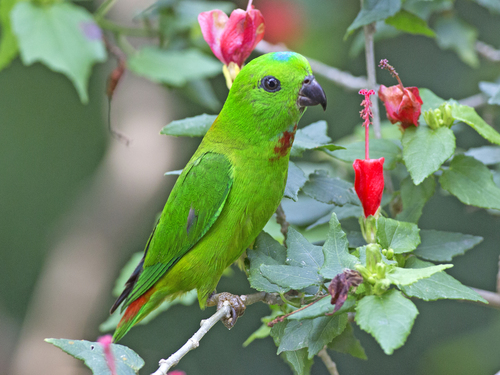
Blue-crowned hanging parrots (Loriculus galgulus) have green plumage, and adult individuals of this species have black beaks. This species shows clear sexual dimorphism between males and females. Adult males have a characteristic blue crown patch on the head, a red marking on the throat, and a red rump bordered by a yellow lower back. Compared to males, adult females have duller green plumage. They lack the red throat marking, have a less apparent or completely absent blue crown on the head, and do not have yellow feathers on their lower back. Juveniles have dull green plumage, little to no visible blue crown patch, and light-colored bills. The calls these birds make while flying are shrill and squeaky; when flying in flocks, their calls are rapid and ringing. While foraging, they produce shrill two-syllable calls. The blue-crowned hanging parrot is distributed across southern Thailand, western Malaysia, Singapore, Sumatra, Borneo, and other nearby islands. It inhabits forests, forest edges, swamps, riverine forest, bamboo patches, mangrove wooded gardens, coconut groves, and plantations. Across its entire range, Sulawesi is the only area where more than one Loriculus species occurs, as intraspecific competition usually prevents other closely related species from having overlapping ranges. In the wild, blue-crowned hanging parrots feed mainly on fruits, including papaya and rambutan. They also eat palm oil nuts, seeds, nectar, and fresh flowers. This species uses different feeding methods. When perching, young birds typically use their mandibles to nibble and break off pieces of food, and flick their heads rapidly to remove pulp after extracting juice. Adults carry food with either their feet or bills, and feed while perching. Adults usually carry food to a perch away from the original food source before feeding. They can bring foot-held food up to their beak to feed, or hold up their foot and lower their head to feed. Another feeding method involves holding food between their claws on the perch, then lowering their head fully to feed.