About Lophosaurus boydii (Macleay, 1884)
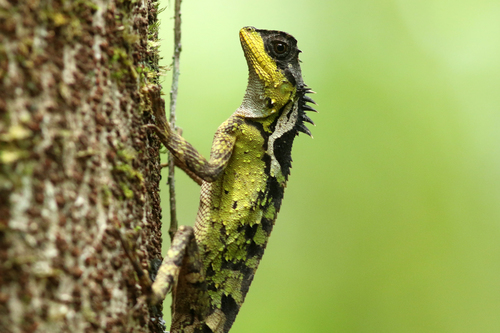
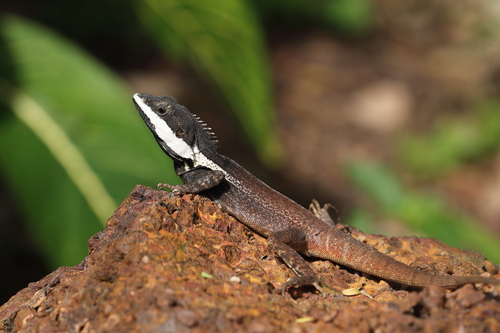
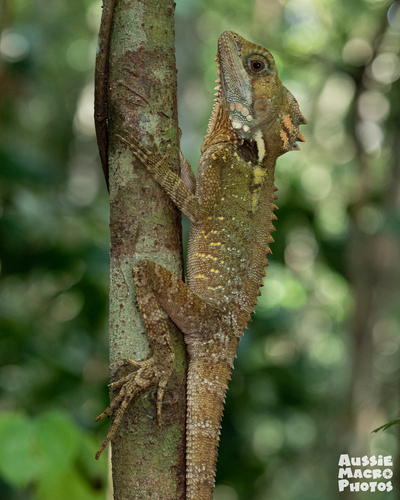
Boyd's forest dragon (Lophosaurus boydii) is generally brown or grey on its upper body, with some individuals having a greenish tint. Its body is laterally compressed. It has very enlarged cheek scales, a prominent nuchal crest, and a yellow dewlap under the chin edged with enlarged spines. The tympanum is large and superficial, lying close to the skin surface. A dorsal crest that is discontinuous from the nuchal crest, made up of enlarged, hardened and pointed scales, runs down to the base of the tail. Adults are sexually dimorphic, with males larger than females and having larger, blockier heads. Adult males grow to an average snout-vent (body) length of about 160 mm (6.3 in), with the tail adding another 325 mm (12.8 in); the average snout-vent length for adult females is about 140 mm (5.5 in) and average tail length is about 280 mm (11 in). The average body mass for adult males is about 150 g (5.3 oz), and for females it is about 100 g (3.5 oz). The species Lophosaurus boydii is restricted to rainforests and their margins in northern Queensland, Australia, ranging from just north of Townsville to near Cooktown. It occurs in both upland and lowland rainforest, and is often seen around Lake Eacham (Yidyam) and Lake Barrine, in parts of Malanda Falls Conservation Park, and at Mossman Gorge. It has been recorded using tree-hollows. Lophosaurus boydii reproduces via eggs, with clutch sizes varying from one to six eggs. Eggs are about 30 mm (1.2 in) long and 15 mm (0.59 in) wide, and weigh about 3–4.5 g (0.11–0.16 oz). Both egg size and weight are higher in upland populations. Females in lowland populations may lay more than one clutch in a season, but their clutch sizes are typically smaller than those laid by upland females. Eggs are laid in shallow nests, often in rainforest clearings that are both natural and man-made—road verges are particularly popular nesting spots. The eggs take about 100 days to incubate. Sexual maturity is reached in around one to two years for lowland populations, but it probably takes at least a year longer for upland populations.