About Lophornis magnificus (Vieillot, 1817)
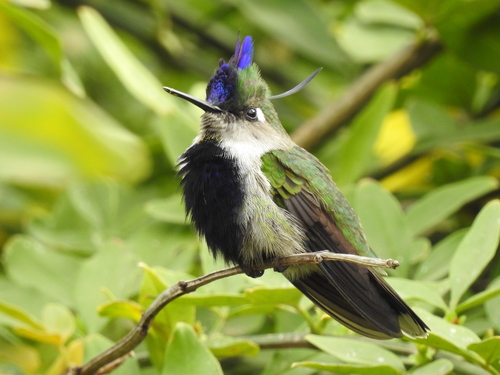
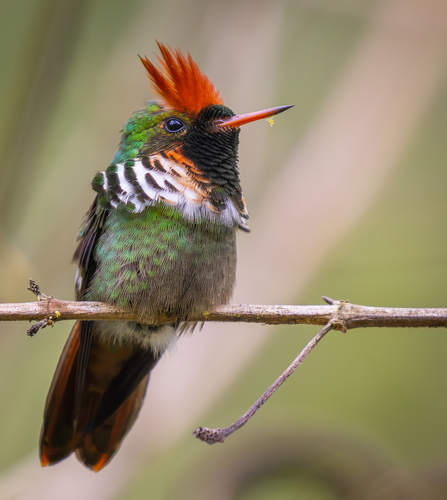
The frilled coquette (Lophornis magnificus) is one of the smallest living birds. It measures 7.1 to 7.7 cm (2.8 to 3.0 in) in length and has an average weight of 2.66 g (0.094 oz). Both sexes share a short, straight, black-tipped red bill, bronzy green upperparts, and a white band across the rump. Adult males are striking: they have a long, rufous-orange erectile crest, green and white fan-shaped cheek feathers, iridescent green forehead and throat, and grayish green underparts. Their central tail feathers are bronzy green, and the rest of the tail feathers are rufous with bronzy green tips and edges. Adult females lack the male’s crest and cheek tufts. They have a whitish throat marked with rufous discs and dark crescents, grayish green underparts matching the male’s, and an overall dark bronze tail with rufous tips. Juveniles resemble adult females.
The frilled coquette is native to eastern and southern Brazil, ranging from Espírito Santo south to Rio Grande do Sul, and west nearly to the borders of Bolivia and Paraguay. It has occasionally been recorded as far north as Alagoas. It lives in semi-open to open landscapes, including humid forest edges, secondary forest, coffee plantations, gardens, and cerrado. Its elevational range extends from sea level up to 1,000 m (3,300 ft).