About Lophophora williamsii (Lem. ex Salm-Dyck) J.M.Coult.
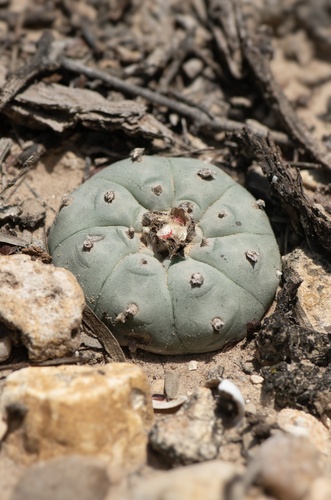
Plants in the Lophophora genus, including this species, grow low to the ground and often form groups with many crowded shoots. Shoots are blue-green, yellow-green, or sometimes reddish-green, most often flattened spheres with sunken tips. They reach 2 to 7 centimeters (0.79 to 2.76 inches) in height and 4 to 12 centimeters (1.6 to 4.7 inches) in diameter. They typically have prominent vertical ribs made of low, rounded or hump-like bumps. A tuft of soft yellowish or whitish woolly hairs grows from the areoles on the tips of these bumps, and no spines are present. Flowers are pink, white to slightly yellowish, or sometimes reddish, opening during the day. They measure 1 to 2.4 centimeters (0.39 to 0.94 inches) long and have a diameter of 1 to 2.2 centimeters (0.39 to 0.87 inches). This cactus produces flowers sporadically. After flowering, it develops small edible pink fruit. The fleshy fruits are club-shaped to elongated, bare, and more or less rosy colored when young, becoming brownish-white and dry at maturity. Fruits do not split open on their own, and measure 1.5 to 2 centimeters (0.59 to 0.79 inches) long. They contain black, pear-shaped seeds that are 1 to 1.5 millimeters long and 1 millimeter wide, which require hot and humid conditions to germinate. Peyote contains a wide range of phenethylamine alkaloids; the primary alkaloid is mescaline, which makes up around 0.4% of the fresh undried plant weight, and 3–6% of the dried plant weight. L. williamsii is native to southern North America, distributed mainly in Mexico, and grows in Southern Texas in the United States. In Mexico, it grows in the northern states of Chihuahua, Coahuila, Nuevo León, and Tamaulipas, extending south to San Luis Potosi and Zacatecas. It is primarily found at elevations of 100 to 1,500 m (330 to 4,920 ft), and exceptionally up to 1,900 m (6,200 ft) in the Chihuahuan desert; it also occurs in the milder climate of Tamaulipas. Its main habitat is desert scrub, specifically thorn scrub in Tamaulipas, and it is common on or near limestone hills. Peyote grows extremely slowly in nature, but cultivated specimens grow much faster, sometimes taking less than three years to go from seedling to mature flowering adult. Faster growth can be achieved by grafting peyote onto mature San Pedro cactus root stock. The disc-shaped crown, the above-ground top portion of the cactus, is commonly cut above the roots and sometimes dried. When harvested correctly, a callus forms on the root tip and the root does not rot, but poor harvesting techniques kill the entire plant. While peyote grows naturally in South Texas, it has been severely over-harvested, leading the state to list it as an endangered species. Cultivation is an important conservation tool for this species, and promoting San Pedro as a peyote substitute may help reduce unsustainable harvest of wild peyote. When used for its psychoactive properties, typical doses of pure mescaline range from roughly 200 to 400 mg. This translates to roughly 10 to 20 g of dried average-potency peyote buttons, but potency varies a great deal between samples, so accurate dosing is not possible without first extracting the mescaline. Mescaline concentration is typically highest along the sides of the peyote button. Psychoactive effects last around 10 to 12 hours. Peyote is reported to produce vivid visual or auditory effects including synesthesia, and spiritual or philosophical insights. In addition to psychoactive use, some Native American tribes use peyote in folk medicine to treat a wide variety of ailments. While uncommon, use of peyote and mescaline has been linked to poisoning. Peyote also contains the alkaloid hordenine, which is also called peyocactin.