About Lopholaimus antarcticus (Shaw, 1794)
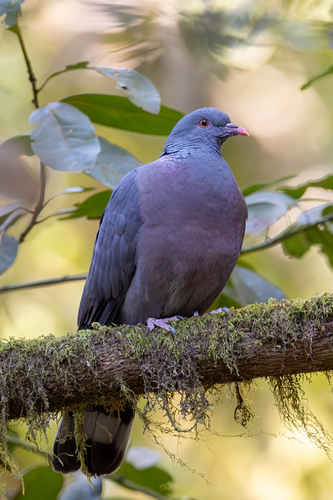
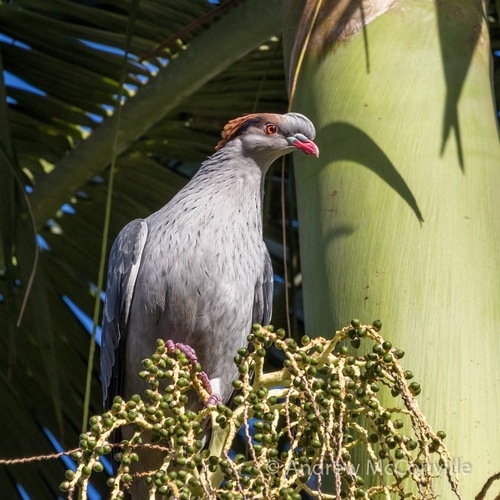
The topknot pigeon, scientifically named Lopholaimus antarcticus (Shaw, 1794), is a large bird with an overall dominant slate-grey colour, and measures 40–46 centimetres (16–18 in) in length. Its back, wing coverts, and upper secondary feathers are a darker shade of slate-grey, with black quills. Its primary flight feathers are black, while the rest of its body is a lighter slate-grey. The chest and hind neck feathers have notched tips that reveal dark bases, creating a streaked appearance. Its black tail is crossed by a broad grey band. The crest is grey from the cere to the forehead, russet brown on the crown, and black along the sides. Both mandibles are red with brown tips; the fleshy protuberances at the base of the mandibles are bluish-green. Its tarsi and feet are purplish red, and its iris is yellow-gold with a bright red outer band; the iris of fledglings is brown. The sexes have similar overall appearance, but males have larger crests and lack some of the chest streaking seen in females. Juveniles resemble females, but have mottled rather than streaked chests, smaller crests, light brown coloration on the cere and forehead, and grey crowns. Juvenile tarsi and feet are reddish brown. This species is distributed from Cape York Peninsula in Queensland down to the central south coast of New South Wales. Topknot pigeons travel long distances to find fruit-bearing trees, and can suddenly appear in areas where they have not been observed for many years. They occasionally move beyond their typical southern range limit into eastern Victoria. There are historic accidental occurrence records for Tasmania dating to 1953, when a specimen was collected at Spreyton near Devonport. This individual was part of a flock of 9 to 10 birds feeding on cherries. Before this 1953 sighting, the only other recorded Tasmanian observation was in 1907, when two specimens were collected near St. Helens on Tasmania's east coast. The 1953 Spreyton specimen is held by the Tasmania Museum, under collection number 13184/B2703.