About Lophocampa ingens Edwards, 1881
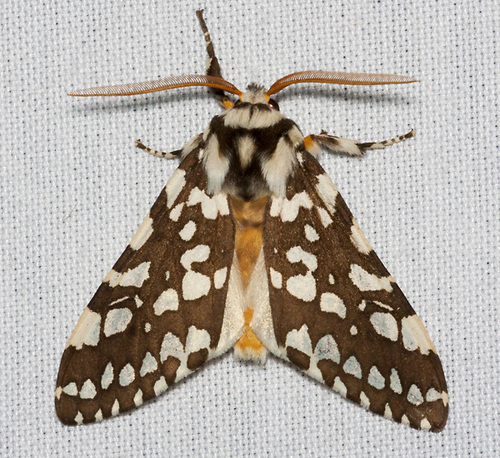
This is the species description of Lophocampa ingens Edwards, 1881, covering male and female traits separately. For males: Eyes are black, the head is pale fawn in color, antennae are stout, long, and rufous. The prothorax is dirty white with a brown median line. Patagia match the prothorax coloration, but are brown at the front. The thorax is brown, with a triangular white spot at its front. The abdomen is dark yellow ochre on the upper side, and banded with brown and pale fawn color on the lower side. Primary wings are dark brown, marked with six irregular bands of white spots. The first band is basal and narrow, with spots fused together to form an irregular curved band. The second row of spots contains a large irregular spot below the median vein, and a long costal spot divided by the subcostal vein. The third row has a similar costal spot, one small spot below the median vein, one large spot above the submedian vein, and one small spot below the submedian vein. The fourth row holds five spots, with the middle spot being very small. The fifth, submarginal row is made of eight lunate spots that decrease in size toward the costa, where they also become more ovate. The sixth, marginal row is made of triangular small spots, with one spot at the end of each nervule. Secondary wings are very pale fawn white, with four darker submarginal spots, with the spots closest to the apex being the largest. Females are similar to males, but have several distinct differences: the head is brown, the spots on the primary wings are larger and slightly more irregular, and the secondary wings only have two spots, with the largest located near the apex. On the underside of the female's secondary wings, there is a dusky shade at the middle of the costa, which connects irregularly to the apical spot. The male wingspan measures 2.00 inches (51 mm), while the female wingspan measures 2.30 inches (58 mm).