About Lophius piscatorius Linnaeus, 1758
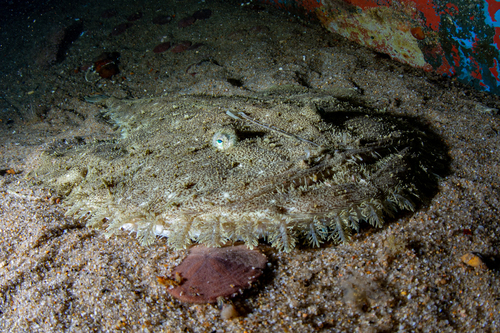
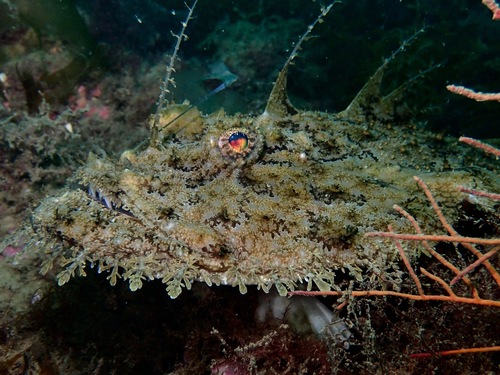
The average body length of the European angler (Lophius piscatorius Linnaeus, 1758) is 40 to 60 centimetres (16 to 24 in), and some larger individuals grow beyond this size range. Exact body size ranges generally differ between localities and populations. Average body size also tends to increase with depth: populations living in deeper waters are larger overall than those in shallow waters. This species has a very large head that is broad, flat, and depressed, while the rest of the body looks like nothing more than an appendage. Its wide mouth extends all the way around the front edge of the head, and both jaws have bands of long, pointed teeth. The teeth slope inwards, and can be positioned to let objects slide toward the stomach without obstruction, while preventing any prey from escaping the mouth. The pectoral and pelvic fins are structured to act like feet, allowing the fish to walk along the seabed, where it usually hides in sand or among seaweed. Fringed appendages that look like short seaweed fronds grow on the skin around the head and along the body. This feature, combined with the fish’s ability to match its body color to its surroundings, helps it camouflage in areas that it chooses because of the abundant prey there. This fish has no scales. The ovaries of female European anglers are made up of two long, ribbon-like lobes connected at their rear ends. One lobe layer produces eggs, while the other produces a gelatinous secretion that fills the ovarian cavity as eggs mature. During the reproductive season, the ovaries swell until they fill the entire abdominal cavity. The male testes are elongated, and have a bean-shaped cross-section. Sperm production starts in sac-like cysts and finishes in the testes’ lumina. European angler lives on muddy and sandy seabeds at depths up to 1,000 metres (3,300 ft), and can occasionally be found on rocky bottoms. They rarely live below the continental slope.