About Lophius americanus Valenciennes, 1837
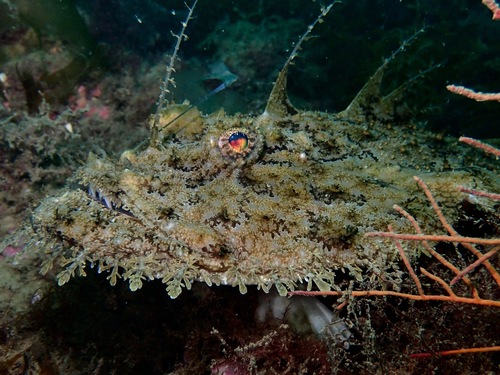
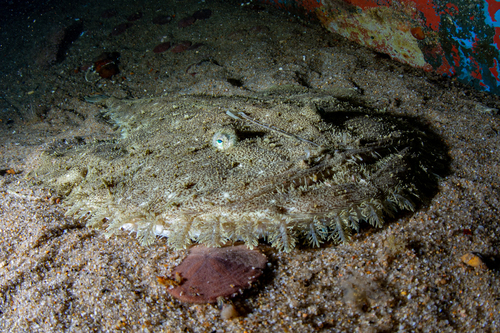
The American anglerfish (Lophius americanus Valenciennes, 1837) has a one-of-a-kind appearance that cannot be confused with any related fish in the areas where it is caught. It is less commercially important as a food fish than other regional species such as cod. Its many common names all reference its unusual characteristics: it has a very large mouth, over twice as wide as its tail, lined with several spines and strong teeth that let it capture prey larger than its own body. Its body is flattened dorsoventrally, an adaptation that allows it to hide on the sea floor. The front of its head bears erectile spines; the longest primary spine has a flattened tip that resembles a small organism or a piece of algae. Its pectoral fins are shaped like wide fans positioned behind the head, while its pelvic fins look like small hands located below the head. American anglerfish can reach a maximum length of 140 cm (55 in), though 100 cm (39 in) is a more typical adult size. The heaviest recorded specimen weighed 22.6 kg (50 lb), and the oldest recorded individual lived to 30 years of age.
This species is found in the western Atlantic Ocean, ranging from Newfoundland and Quebec south to northern Florida. It is more abundant in the northern parts of its range, specifically north of Cape Hatteras. It is a demersal fish that lives close to the seabed at depths down to approximately 2,000 feet (610 m). It occupies seabeds made of sand, gravel, shell fragments, mud, and clay.
As a food fish, most of the edible flesh of the American anglerfish is found on its main body, with smaller amounts located on the 'shoulders' and cheeks. The raw flesh is very white and moist, and becomes quite firm once cooked. It is served both in soups and grilled, and has a texture similar to crustacean meat. Its fillets are thick and boneless, resembling crab or lobster tail. Connoisseurs consider the liver of the American anglerfish to be an excellent food; in Japan, it is prepared and eaten as ankimo. The fish's body is covered in soft, scaleless, elastic skin, and a thin, edible membrane lies underneath this outer skin to cover the flesh. Though parasitic worms are far less common in American anglerfish than they are in cod, they can sometimes be found in the fish's flesh. The pale opacity of these worms makes them easy to spot. They typically occur between the outer skin and the outer layer of flesh, and range in size from a few millimeters to over one inch.