About Lontra longicaudis (Olfers, 1818)
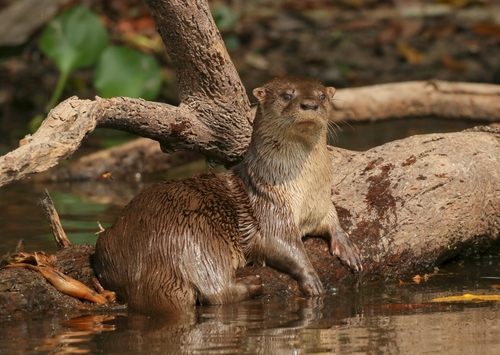
The Neotropical otter (Lontra longicaudis) has short, dark grayish-brown fur, with lighter coloration around its muzzle and throat. It has a long, wide tail, short stout legs, and fully webbed toes. This species is sexually dimorphic: males are roughly 25% larger than females. Head-and-body length ranges from 36 to 66 centimetres (14 to 26 in), with an additional tail length of 37 to 84 centimetres (15 to 33 in). Body mass typically falls between 5 and 15 kilograms (11 to 33 pounds). Neotropical otters communicate with other nearby otters through scent marking, and may also use whistles, hums, and screeches to communicate. Their dental formula rarely differs from that of Eurasian otters (Lutra lutra), except in rare cases of individuals with dental anomalies. Males and females share the same dental formula. For one half of the skull, the dental formula is: upper jaw: 3 incisors, 1 canine, 4 premolars, 1 molar; lower jaw: 3 incisors, 1 canine, 3 premolars, 2 molars. Among all Lontra species, the Neotropical otter has the widest distribution. Its range extends from northwest Mexico to central Argentina. Neotropical otters prefer clear, fast-flowing rivers, and rarely settle in slow, silt-heavy lowland waters or boggy areas. While they mostly occur at elevations between 300 and 1,500 m (980 to 4,900 ft) above sea level, they have also been found living at 3,000 m (9,800 ft). They need dense riparian vegetation and plentiful den sites, but aside from these requirements, they are highly versatile and tolerant of environmental change. They prefer dens that are solid, located at a high elevation, dry, and close to deep water. Neotropical otters are the most generalist feeders and habitat generalists of all otter species. In addition to rivers and streams, they can live in and use a range of less typical habitats, including wastewater treatment plants, rice paddies, sugar cane plantations, estuaries, deltas, drainage ditches, and occasionally swamps. They can also inhabit cold glacial lakes and streams in the Andes of Ecuador and Colombia. They will also travel to seashores and beaches, living an almost brackish lifestyle where they hunt marine life and play in highly saline water. Most Neotropical otter breeding takes place in spring. Gestation lasts 56 days, and produces a litter of 1 to 5 pups. Pups are born blind but fully furred. They leave their mother's nest at around 52 days old, and start swimming at 74 days old. All pup rearing is done by the mother, as males provide no parental care. Males only spend one day with females during the breeding season. Females must protect their pups from predation by other Neotropical otters. In one captive breeding case, cannibalism by the mother was suspected but not confirmed. In ecologically healthy areas, many potential dens are available, so individual otters can select their preferred site. However, studies show that not all available dens are occupied, and not all dens are used equally by Neotropical otters. Otters visit different dens at different frequencies, ranging from once or a few times a year to many times per year. One key factor affecting den preference is water level, especially during flood season, since a den near the water level can easily be washed away. Dens can sit at the water level near the bank, or more than 1.5 meters above the water level. Many other factors also influence Neotropical otter den preference. They prefer dens close to fresh water, areas with high food availability, and relatively deep, wide water. During low-water seasons, individual otters tend to cluster more, as all move to deeper parts of the river that hold more fish. Deep, wide pools support greater fish diversity, which is preferred by otters. Some studies show that otters will leave a less suitable but more available den, such as one in a muddy river bank, to spend more time in a preferred den, such as one on a rocky shore. Female Neotropical otters raise pups in dens without a male present, and some females find dens with separate space for pups and their own use. A study of a male otter's movements over 35 days found he used three different dens with no shared use between other otters. This individual moved between two islands separated by a one-kilometer wide estuary. He spent time in an area with heavy mud, which is poor substrate for a den, suggesting he was moving to find food. Dens often have multiple openings, which allow otters to easily exit to forage while remaining safe from predators. Neotropical otters use several types of dens. They prefer cavities between stones or under tree roots. In some parts of South America, otters may encounter natural limestone dissolution cavities or cavities in rocky cliffs. Even though these cavities have no natural light, Neotropical otters can use these sturdy homes effectively. As a last resort, otters will expend energy to dig their own den in vegetation or a river bank, though these dens are less sturdy. Vegetative cover is also very important for Neotropical otters. Unlike the dens of other otter species, Neotropical otter dens do not have openings that open directly into water, do not use plant material for bedding, and otters will readily live in dark caves. They are elusive animals that prefer undisturbed forests with no signs of human activity. When people clear forests for agricultural land, the amount of available habitat for Neotropical otters drops sharply.