About Lonicera utahensis S.Watson
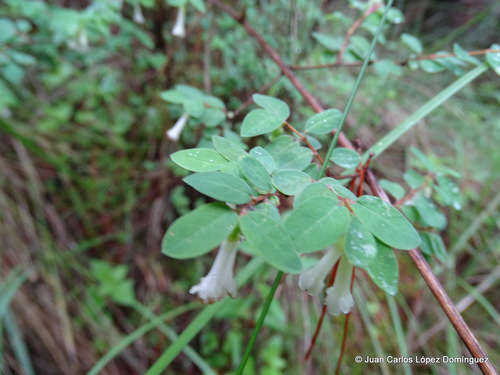
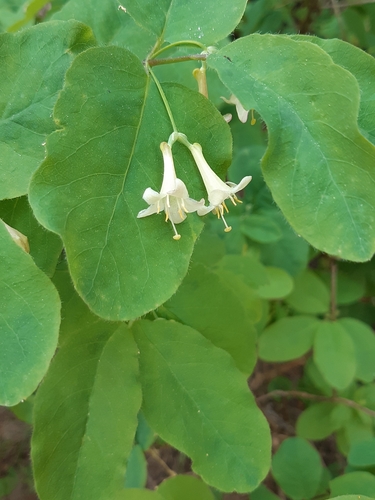
Lonicera utahensis S.Watson, commonly known as Utah honeysuckle, is a deciduous shrub. It reaches 1 to 2 metres (3+1⁄2 to 6+1⁄2 ft) in height, with slender, spreading branches, and often grows in a clumpy form. Its leaves are oval or oblong, measuring up to 8 centimetres (3+1⁄4 in) long and 4 centimetres wide; leaf undersides are either hairless or covered in stiff hairs. Flowers grow in pairs on peduncles up to 15 cm (6 in) long, with yellow to yellowish-white petals up to 1 cm long. The plant produces a red berry nearly 1 cm wide. Its seeds are dispersed by animals that eat the fruit, including birds and bears. This species is native to western North America, ranging from British Columbia, Washington, and Oregon east to Alberta and Montana, and south through the Rocky Mountains to Arizona and New Mexico. It grows in the understory of mature forests, for example stands made up of grand fir and Rocky Mountain maple. It is often a climax species, and may be a codominant plant in subalpine fir-common beargrass plant communities. It occurs at elevations between 300–3,400 m (980–11,150 ft), and is most commonly found between 1,200–2,400 m (3,900–7,900 ft). Other plant species frequently associated with it include white spiraea, ninebark, Scouler willow, Sitka alder, thinleaf huckleberry, pinegrass, queencup beadlily, and sweetscented bedstraw. This honeysuckle can be used as an ornamental plant and for revegetation projects. Its berry is considered edible.