About Lonicera sempervirens L.
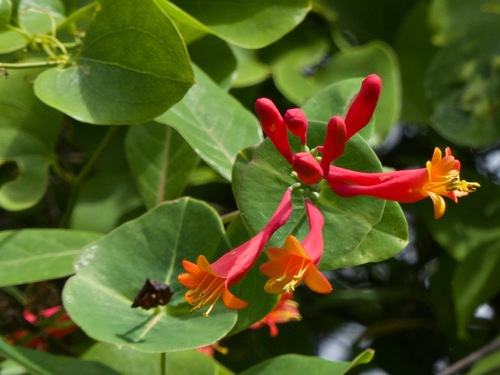
Lonicera sempervirens L. is most easily identified by its trumpet-shaped flowers, which range in color from coral to reddish. Like many other species in the honeysuckle genus, its leaves and stems have a waxy coating. It is a twining vine that can reach 20 feet or more in length, growing up through shrubs and young trees. Its leaves grow in opposite pairs, are oval in shape, and can reach up to 5 cm long and 4 cm wide; the leaves located directly below the flowers are perfoliate, joined at the base to form a complete ring around the shoot. Flowers are borne in whorls at the end of shoots. After flowering, the plant produces red berries that are less than 1 cm in both width and length. These berries are inedible, and develop from summer through fall. This species is somewhat evergreen, and it is flammable, so it is not recommended for planting close to residences. Flowers grow on new growth in clusters of several groups of three flowers each. They are tubular, 5 cm long, with five small lobes that open at the tip to expose the stamens and stigma. Young bark is green and fuzzy, and lightens to brown as the plant ages. Older stems develop a distinct red-orange color. Lonicera sempervirens is most common in eastern North America, and has been found as far west as Texas. It occurs prominently throughout the southeastern United States. It is listed as endangered in Maine, which is the only U.S. state where this species has any legal protected status. While it is an introduced species in some parts of New England, apparently native populations have been recorded in Connecticut, Massachusetts, and Rhode Island. It is considered extremely rare within Rhode Island. This species is most common in coastal habitats. Lonicera sempervirens is frequently used as a non-invasive alternative to Lonicera japonica along the east coast of North America. It is popular for cultivation in gardens and recreational areas because it requires very low maintenance. It is often planted in pollinator gardens to attract hummingbirds and butterflies. It is primarily grown as an ornamental plant for training on fences or lattices, valued for its attractive bright red flowers. It can be propagated either by stem cuttings or from seed. In Native American traditional medicine, it has been used to treat asthma and bee stings. Several cultivars of this species exist: 'Magnifica', which blooms later and produces more flowers; 'Sulphurea', which has sulfur-yellow flowers; and 'Superba', another heavy-flowering selection with bright red flowers. Thanks to its cold hardiness, Lonicera sempervirens can grow in a wide range of areas, and is winter hardy in USDA zones 5 through 9. It prefers sunny, moist locations but is also drought tolerant. It can grow in well-drained clay or loam soils, and prefers acidic soil with a pH of 6. It tolerates both full sun and full shade. Deer typically avoid browsing this plant, and it is also juglone-resistant, meaning it can tolerate growing near walnut trees. Many wildlife species use Lonicera sempervirens for food; butterflies and hummingbirds most commonly feed on its nectar. It attracts bees, hummingbirds, moths, and songbirds. Birds including quail, purple finch, and American robin eat its red berries. Ruby-throated hummingbirds and various insect species pollinate its bright red to pinkish-red flowers from mid-spring through fall. It is a host plant for the caterpillars of spring azures and snowberry clearwing moths. It provides moderate cover for animals, and has a relatively low nutritional value.