About Lonicera maackii (Rupr.) Maxim.
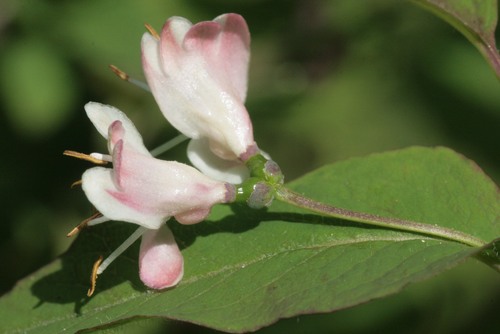
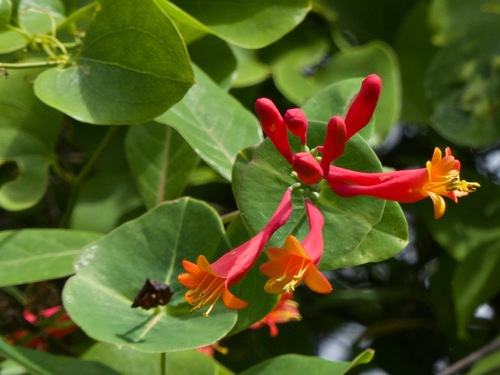
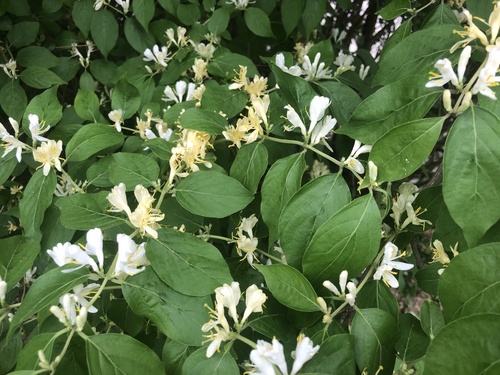
Lonicera maackii (Rupr.) Maxim., commonly called Amur honeysuckle, is a large deciduous shrub. It reaches a maximum height of 6 metres (20 ft), with stems growing up to 10 centimetres (4 in) in diameter. Its leaves are oppositely arranged, measuring 5–9 centimetres (2–3+1⁄2 in) long and 2–4 centimetres (3⁄4–1+5⁄8 in) broad, with smooth entire margins and at least some rough pubescence. Flowers grow in pairs; each flower is 2 centimetres (3⁄4 in) long, two-lipped, starts white, and later changes to yellow or pale orange. Blooming occurs from mid-spring to early summer. The fruit is a bright red to black, semi-translucent berry 2–6 millimetres (5⁄64–15⁄64 in) in diameter, which contains numerous small seeds. Amur honeysuckle is cultivated as an ornamental plant for its attractive flowers, and is also used for hedges. Many cultivars have been selected for horticulture, including 'Erubescens' with pink flowers and 'Rem Red' with an erect growth form. The species is adaptable and thrives in a wide range of growing conditions. In the United States, it was historically planted to control erosion and create hedges. It self-propagates easily, as birds disperse its seeds, and spreads quickly into habitats where it has no natural community connectivity. It grows rapidly, and prefers shady habitats including woodland understories, neglected urban areas, and fence rows, where it can form very dense thickets. Children sometimes eat the flowers: they remove the blossoms, pull off the bottoms, and suck the sweet nectar from the center. The berries are mildly poisonous to humans, so they should not be consumed.