About Lonicera hispidula (Lindl.) Douglas ex Lindl.
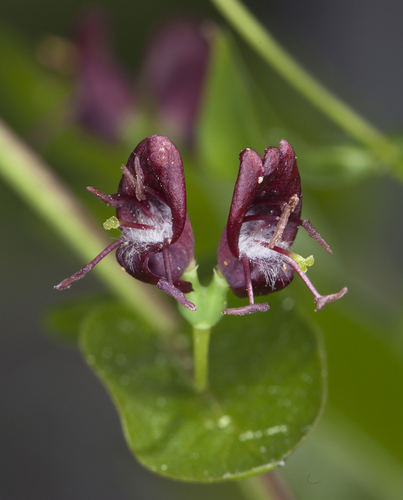
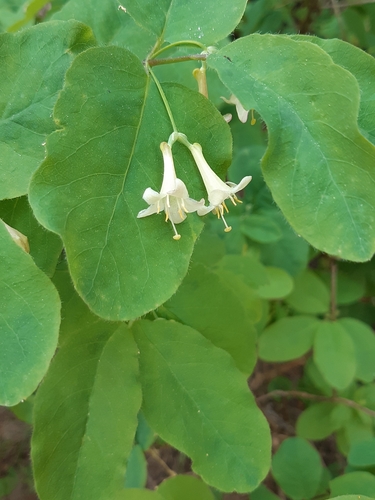
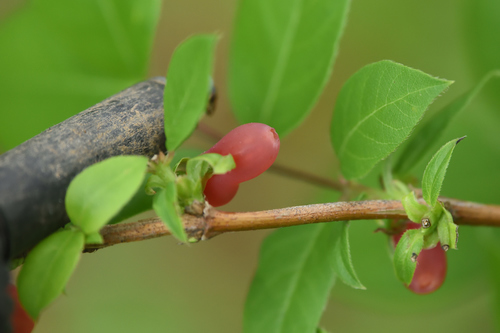
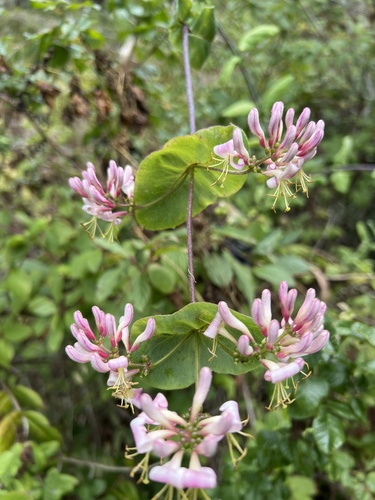
Lonicera hispidula, also known as pink honeysuckle, is a perennial shrub or vine. Like other honeysuckles, it has pairs of leaves that grow opposite each other on the stem, with the uppermost pair fused at their bases to surround the stem. Leaves have a simple form and smooth, unserrated edges. When its branches cling to another plant or surface, the branches grow outward, while the center of the plant becomes a bushier, more structured shrub. Pink blossoms grow at the end of stems, though flower colors can also include white, dark red rose, purple, or light yellow. The flowers are tubular and slightly curved, and the whole flower including petals is described as having an ovate shape. This species has a unisexual breeding system, with male and female reproductive organs held in separate flowers, and it is dioecious, meaning individual plants are either male or female. Flowers are arranged in a spike inflorescence: they grow lined up vertically along a long, thin unbranched axis, blooming from the base to the tip as the spike stretches out. Lonicera hispidula grows in riparian zones and woodland areas. It is common in coastal riparian areas and mountains of California, and has also been found west of the Cascades in Washington and Oregon. It is often found near canyons, streams, and woodlands, at elevations between 1,500 and 3,500 feet. It normally blooms in spring, specifically during the months of May and June, depending on environmental conditions. It produces small, fleshy berries that contain seeds; mature ripe berries are red and measure 8 mm across. The flowers attract hummingbirds, and the fruits are eaten by other birds. This plant also attracts butterflies and bees. It can grow in full sun or shade, and grows best in acidic, dry to moist soils. According to the Lady Bird Johnson Wildflower Center, the berries may be mildly poisonous if eaten. Sensitivity to the toxin varies by a person's age, weight, physical condition, and individual susceptibility, with children being most vulnerable due to their curiosity and small body size. The berries contain saponins that can be mildly toxic to humans if ingested; other parts of the plant do not contain toxic levels of this compound. Historically, the hollow, sturdy stems of Lonicera hispidula were used as smoking pipes by the Pomo people, and burned wood ashes from the plant were used for tattooing. Today, it is cultivated by specialty native plant nurseries as an ornamental plant for drought-tolerant wildlife gardens and natural landscaping, primarily in California. It is generally pest and disease free, and is considered a low maintenance plant that thrives with minimal care, making it well-suited for wildlife gardens. Lonicera hispidula has been documented acting as a host for the sudden oak death pathogen, which causes a deadly canker disease in multiple oak species native to California and Oregon.